CreatorClaw AI Review Can This 7-Agent Course Builder Really Turn Ideas Into Sellable Courses for $37?
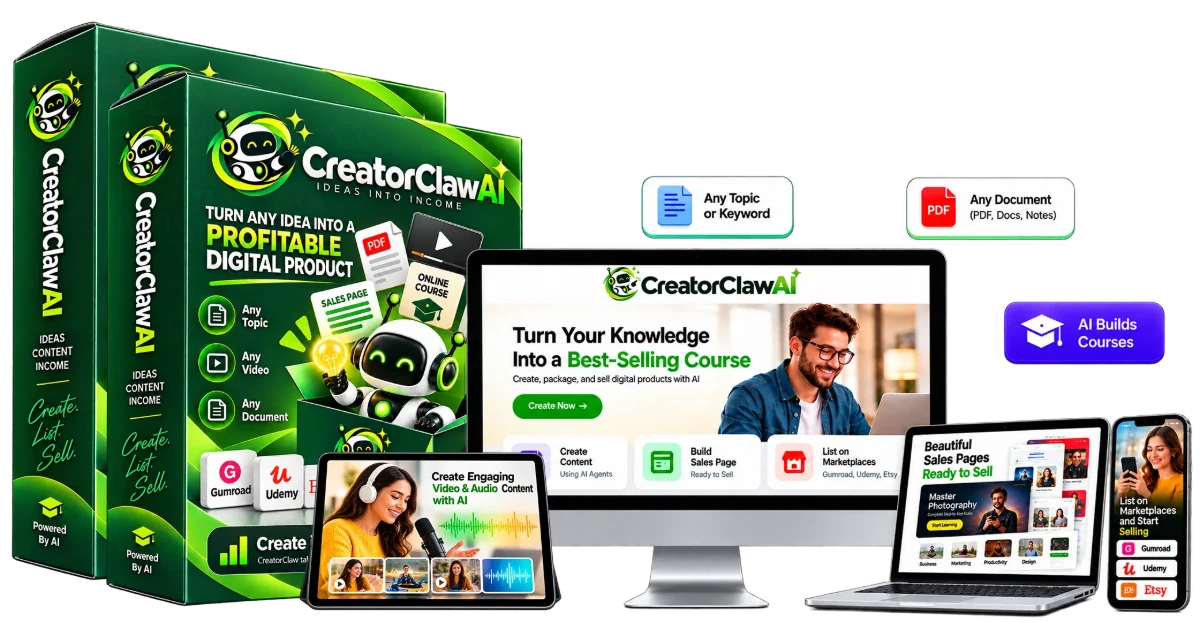
Online courses are still one of the most popular ways to build a digital income, and also one of the most exhausting. You have an idea, maybe even real expertise, and then reality shows up. You need an outline. You need lessons written. You need a voice, a camera, or at least a slide deck. You need editing, exporting, packaging, and then a marketplace listing that doesn't get ignored. Weeks pass. Sometimes months. A lot of would-be course creators never get past the first module. This CreatorClaw AI review looks at a tool that promises to squeeze that whole process into a single automated pipeline.
I went through the product details, looked closely at how the funnel is structured, and tried to judge it the way a regular marketer or side-hustler would, someone who wants results without a production crew. Below you'll find what it does, what each price tier adds, who should buy, who should pass, and where I think the real value (and the real limits) sit.
Quick preview: the front end is cheap and surprisingly complete, the upgrades are well thought out but they add up, and as with any AI tool, the quality of what you publish still depends on you. Let's break it down.
What Is CreatorClaw AI?
CreatorClaw AI is a course creation platform built around what the vendor calls a full AI course creation pipeline. Instead of giving you one tool for writing, another for voiceovers, and a third for video, it bundles the whole chain into one system run by seven AI agents. Each agent handles a different stage of the job, so a single idea can travel from rough concept to a finished, upload-ready course without you stitching pieces together by hand.
The front-end version includes all seven agents, which I think is an important detail. Many software launches hold back their best features for a pricey upgrade and hand you a crippled version for the entry price. Here, the core pipeline is intact from the start. What the upgrades change is mostly volume, quality settings and business tools, not whether the basic machine works.
The output is meant to be practical. We're talking about finished courses with video, voiceover and formatting that fits marketplace requirements, ready for you to sell. For people who have always wanted to launch a course but got stuck on the production side, that's the whole appeal.
Why Making Courses the Old Way Is So Hard
To understand where CreatorClaw AI fits, it helps to remember what a normal course launch involves.
Planning and Writing
First you research your topic and decide what to teach. Then you structure it into modules, write lesson scripts, create worksheets, and make sure the whole thing flows logically. Even for someone who knows the subject well, this takes days. For someone who doesn't, it takes much longer.
Recording and Editing
Next comes production. You record your voice or yourself on camera, deal with background noise and bad lighting, edit out mistakes, add visuals, and export everything in the right format. Plenty of people quit at this stage, because it feels like a second full-time job.
Packaging and Listing
Then you prepare the course for a marketplace or your own site. That means correct file formats, titles, descriptions, and thumbnails. Marketplaces have their own rules, and a small mistake can delay approval.
Keeping It Updated
Finally, courses go stale. Information changes, links break, screenshots look outdated. Keeping a catalog fresh is a chore most creators underestimate.
Put all that together and it's easy to see why a tool that handles most of the steps is attractive. The question is how well it handles them.
==> Get The Full CreatorClaw AI Buying <==
Key Features of CreatorClaw AI
Seven AI Agents Working as a Pipeline
The core idea is a team of seven agents, each responsible for a stage of the creation process. The benefit of this setup, compared with a single prompt box, is structure. Instead of asking a chatbot to magically produce a course, you're moving through a system that was designed around how courses are actually made. That tends to give more consistent results, and it means you aren't constantly rewriting instructions to get the output you want.
Ten Courses Per Month on the Front End
The $37 entry version allows up to ten courses a month. Honestly, that's more than most people will realistically publish and market. Even a busy creator will struggle to properly promote ten new courses every month, so for many buyers this limit won't feel limiting at all.
Video Rendering
The front end comes with 30 minutes of video render. That's enough to produce a handful of short courses or a few lessons of a longer one. It's a sensible starting allowance, and it's also where you'll first feel the ceiling if you plan to produce a lot of content. Heavy users will probably want the unlimited video minutes that come with the first upgrade.
Standard AI Voices
Voiceovers on the base plan use standard AI voices. They do the job, and they save you from recording yourself. If you're a perfectionist about audio quality, or you want your course to sound more premium, the Pro upgrade adds better voices, which I'll cover below.
Marketplace-Ready Format
The front end includes one marketplace format. That means your finished course can be exported in a layout that fits a marketplace's requirements, without you reformatting everything manually. Starting with one format keeps things simple, and you can expand later if you plan to sell in more than one place.
The Update Agent
One of the more interesting pieces in the funnel is the Update Agent, which is unlocked with the Pro upgrade. The idea is to help you refresh existing courses, so they don't go stale. Keeping content current is something course sellers often neglect, and an automated helper for it is a practical addition rather than a gimmick.
How CreatorClaw AI Works Step by Step
From the way the product is described, a typical workflow looks something like this.
• Start with a topic. You enter the idea or niche you want to build a course around.
• Let the agents build. The pipeline moves through the stages of outlining, writing, voiceover and video creation.
• Review and adjust. You read through what was generated and fix anything that doesn't match your goals or your voice.
• Export for your marketplace. The finished course is formatted so it's ready to upload.
• Publish and promote. You list it, share it, and send traffic to it.
Notice that step three is yours. No matter how good the automation is, a human pass makes the difference between a course that sells and one that disappears. More on that later.
Who Is CreatorClaw AI For?
Beginners who want to start selling digital products are the obvious audience. If you've never made a course because the production work felt too heavy, this removes most of that weight.
Affiliate marketers and online sellers who want their own products rather than only promoting other people's will also find it appealing. Having a catalog of your own courses gives you more control and better margins than relying solely on commissions.
Coaches and consultants can use it to turn what they already know into a structured course, which is a good way to serve people who can't afford one-on-one work.
Agencies and freelancers can use the higher tiers to build courses for clients and deliver them under their own brand. The funnel has options aimed squarely at that.
Who should skip it? People who want a deeply personal, highly polished course built around their own face and voice may find the automated approach too generic. And if you're not willing to review and improve what the AI produces, you'll likely end up with average content that doesn't stand out.
Pros and Cons
What I Like
• Complete pipeline from the start. All seven agents are included in the front end, so nothing feels crippled.
• Very low entry price of $37 for a tool that covers writing, voice and video.
• Generous course limit of ten per month on the base plan.
• Clear upgrade path, with options for volume, ready-made content, selling tools, client work and resale.
• Update Agent helps keep courses current over time.
What Could Be Better
• Only 30 minutes of video render and one marketplace format on the front end, so serious users will outgrow it.
• Standard AI voices won't suit everyone's taste.
• The funnel has five upgrades plus a bundle, so it's easy to overspend.
• AI-generated content needs a human review to feel original and trustworthy.
==> Read The Truth CreatorClaw AI Today <==
CreatorClaw AI Pricing and Funnel Breakdown
This is the part many people want to see first, so here is the full lineup. There is one front-end product, five optional upgrades, and a bundle that combines everything.
|
Offer |
What It Is |
Price |
|
Front End |
CreatorClaw AI (Full AI Course Creation Pipeline) |
$37 |
|
OTO 1 |
Pro / Unlimited |
$47 |
|
OTO 2 |
DFY Course Pack |
$67 |
|
OTO 3 |
Storefront |
$67 |
|
OTO 4 |
Agency |
$127 |
|
OTO 5 |
Reseller |
$197 |
|
Bundle |
Everything Above (Complete Access) |
$267 |
Let's go through each one.
Front End: CreatorClaw AI ($37)
This is the foundation. You get all seven agents, up to ten courses a month, 30 minutes of video render, standard AI voices and one marketplace format. For the price of a couple of coffees, you get a working course-making system. If you're unsure about the whole concept, this is the only purchase you need to test it. It's low risk, and you can decide on upgrades once you've seen real results with real courses.
OTO 1: Pro / Unlimited ($47)
This upgrade removes the main ceilings of the front end. You get unlimited courses and unlimited video minutes, the Update Agent, premium voices and AI avatars, all marketplace formats, HD export and priority rendering.
For anyone serious about producing content regularly, this feels like the natural next step, and at $47 it's priced fairly. Premium voices and avatars make courses feel more professional, HD export improves how they look, and priority rendering saves waiting time when you're working in bulk. If you plan to sell on several marketplaces, having all formats available is also a real convenience. My take: if you decide to keep using the tool after the first week, this is the upgrade most likely to be worth it.
OTO 2: DFY Course Pack ($67)
DFY means done for you. This package gives you 50 ready-made courses with videos included, marketplace listings included, in top-selling niches, ready to upload today.
The appeal is speed. You skip the creation step completely and go straight to publishing. That's useful if you want to build a catalog quickly or you're not sure which niches to pick. The trade-off is that ready-made content isn't unique to you, so I'd treat it as a starting point and customize it where you can, rather than uploading everything unchanged. Used that way, it can save a huge amount of time.
OTO 3: Storefront ($67)
Not everyone wants to depend on marketplaces. The Storefront upgrade lets you sell directly through your own personal storefront with a custom domain, Stripe or PayPal checkout, a members area and a buyer list.
Building a buyer list matters more than most beginners realize. When you sell only through a marketplace, the marketplace owns the customer relationship. With your own storefront, you own it, which means you can email people about new courses and offers. If you want to build a long-term business instead of a one-off project, this upgrade deserves serious thought.
OTO 4: Agency ($127)
The Agency upgrade is for people who want to use CreatorClaw AI to serve clients. It includes client accounts, white-label options, a custom domain per client store, client contracts and proposals.
This is basically a business-in-a-box angle for selling courses as a service. If you already have clients, or you're comfortable pitching local businesses, coaches or consultants, the included contracts and proposals take care of some of the paperwork that usually slows people down. If you have no intention of working with clients, you can safely skip it.
OTO 5: Reseller ($197)
The most expensive upgrade lets you sell CreatorClaw AI as your own product, keep 100 percent of the sales, and use the included sales materials. It's the highest-ticket item in the funnel and it's aimed at people who see themselves as software sellers rather than just course creators.
Reselling can be lucrative, but it also requires real marketing work, and the price is higher than anything else here. I'd only consider it if you already know how to drive traffic to software offers and you want a product to sell without building one yourself.
Bundle: Everything Above ($267)
The bundle packages the front end and all five upgrades into one purchase. Adding up the separate prices ($37 + $47 + $67 + $67 + $127 + $197) gives $542, so the bundle saves you $275. That's a real discount, but only if you'll actually use every part of it. A lot of people buy the complete package out of excitement and then touch only a fraction of it.
==> Click Here to Get CreatorClaw AI at a Discount Price <==
Which Option Should You Pick?
If you're brand new and want to test the idea, start with the $37 front end and nothing else. Make one or two courses and see how you feel about the quality and the workflow.
If you already know you'll create regularly, add Pro / Unlimited. It removes the limits and improves the voices and export quality, which is where most people feel pinched first.
If your biggest problem is getting started quickly, the DFY Course Pack gives you a stocked catalog on day one.
If you want to own your customers, look at Storefront. If you want to work with clients, look at Agency. If you want to sell the software itself, look at Reseller.
And if you're confident this is your main business tool, the $267 bundle is the cheapest way to get all of it. My usual advice with any funnel applies here: buy the first thing, use it for real, then upgrade for specific reasons. You can add more later, but you can't undo a purchase you didn't need.
Real-World Ways to Use CreatorClaw AI
Launch a Side Income Stream
Pick a niche you understand, build a few focused courses, and list them on a marketplace. With the pipeline doing most of the heavy work, a part-time creator can realistically build a small catalog in the time it would normally take to finish one course by hand.
Add Products to an Existing Audience
If you already run a blog, a YouTube channel or an email list, courses are a natural product to add. You know what your audience asks about, so you can turn those repeated questions into structured lessons.
Serve Clients Under Your Own Brand
With the Agency features, you can build course stores for clients and deliver them under your own branding. For small agencies and freelancers, that opens a new service line without hiring a production team.
Refresh Old Content
If you already have courses that feel outdated, the Update Agent gives you a faster way to bring them back to life instead of starting over.
Is CreatorClaw AI Worth the Money?
Let's look at the cost side honestly. If you hired someone to write scripts, record voiceovers and edit video for even one short course, you would likely spend far more than $37, and you'd pay again for the next course. A tool you own changes that equation, because the cost of your tenth course is close to the cost of your first.
The catch, of course, is time and effort on your side. The software handles production, but you still choose the topic, review the output and promote the finished product. If you're willing to do those parts, the price is easy to justify. If you were hoping for a button that produces income with no work, no software on the market, at any price, will give you that.
A good way to judge it is to ask how many courses you realistically want to make in the next three months. If the answer is one or more, the front end pays for itself in saved time alone. If the answer is zero, save your money.
Choosing a Niche for Your First Course
Because the tool makes production easy, the biggest decision becomes what to make. A few simple rules help here.
Start with something you already understand, or at least something you can verify quickly. It's much easier to review and improve AI-written lessons when you know whether they're correct. Pick a topic where people have a clear, practical problem, such as learning a skill, saving time, or reaching a specific goal. Courses that promise a concrete result tend to be easier to explain and easier to sell than vague ones.
Look at what already exists. If a marketplace has hundreds of generic courses on a broad topic, a narrower angle gives you a better chance of being noticed. Think about who the course is for and what stage they're at. A course for complete beginners in one specific area can outperform a huge all-in-one title.
Finally, think about what you can add. Your own experience, short case studies, simple templates or a checklist can turn an average course into one that feels worth paying for.
Common Mistakes to Avoid
• Publishing without editing. Raw output often reads like raw output. A single review pass improves quality a lot.
• Making too many courses too fast. Quantity without promotion just creates a pile of unsold products.
• Ignoring marketplace rules. Always check current guidelines before you upload anything.
• Buying every upgrade at once. Figure out your actual bottleneck first, then spend money to solve that specific problem.
• Skipping the customer list. If you can collect emails, you own the relationship, and that's where long-term income usually comes from.
Avoid those five and you're already ahead of most people who buy tools like this and never get past the first week.
Setting Realistic Expectations
Let me be straight about something that sales pages rarely say clearly. A tool that creates courses does not create customers. Plenty of people will use CreatorClaw AI to build courses, and some of those courses will sit unsold because nobody saw them. Creating the product is one half of the job. Choosing a good niche, writing a clear title and description, and driving traffic is the other half.
Quality also matters. Marketplaces and buyers are getting better at spotting generic, low-effort material. If you publish raw AI output with no editing, you risk reviews that hurt you and refund requests. The smart way to use a tool like this is as a very fast first draft. Add your own examples, your own opinions and your own experience, and the result will look and feel far better than something produced on autopilot.
Finally, remember that marketplace rules can change. Always check the current requirements for any platform you plan to use, and make sure your content follows them.
A Simple Plan for Your First Week
If you decide to try it, here's a low-pressure way to get started without wasting money or energy.
On day one, pick a single narrow topic and generate one course. Don't worry about perfection, just see what the pipeline produces and how close it is to what you imagined. On day two and three, read everything carefully, fix awkward parts and add a few examples from your own experience. By day four, prepare a clear title and description, and set up your listing on the marketplace you want to use. On day five, publish, then spend the rest of the week sharing it with people who might genuinely benefit from it.
That small loop, create, improve, publish, promote, teaches you more than any amount of reading about courses. Once you see how the process feels, you'll know much better whether the upgrades are worth buying for you.
The real advantage of a tool like this isn't that it removes work entirely. It's that it shortens the distance between having an idea and having something real in front of customers. That speed lets you test more ideas, learn faster, and keep what works.
Tips to Get Better Results
• Choose a narrow topic. Specific courses tend to sell better than broad ones, and they're easier for the AI to handle well.
• Edit every course. Read it through, fix awkward phrasing, and add personal examples.
• Test the tool on one course before scaling. Don't generate ten at once until you're happy with the quality.
• Use the DFY pack as raw material. Customize titles, descriptions and a few lessons so your catalog feels like yours.
• Build a list early. If you add Storefront, start collecting emails from your very first sale.
CreatorClaw AI vs. Other Ways of Making Courses
Compared with creating everything manually, CreatorClaw AI is dramatically faster. You trade some personal polish for speed and cost, and for many sellers that's a good trade.
Compared with hiring freelancers for scripts, voiceovers and video editing, it's far cheaper and doesn't involve waiting on other people. The downside is less custom creative control.
Compared with assembling several separate AI tools yourself, the main advantage is that everything lives in one pipeline, so you don't have to juggle subscriptions, file formats and prompts. That alone is worth something if your time is limited.
Final Verdict on CreatorClaw AI
CreatorClaw AI is a practical, fairly priced answer to a real problem. The $37 front end is generous, giving you all seven agents and enough monthly capacity for almost anyone starting out. The upgrades are logically organized, with Pro / Unlimited being the one most users will find genuinely useful, and the Storefront, Agency and Reseller options serving people with bigger business plans.
It's not magic, and it isn't a replacement for knowing your audience or for putting effort into quality. But as a way to cut weeks of production work down to a much shorter process, it looks like a strong option. My advice is to start small, test it with a real course idea, edit what it gives you, and only then decide which upgrades make sense for your goals.
One more thing worth saying. The people who get the most from tools like this are rarely the ones with the fanciest ideas. They're the ones who ship consistently, listen to feedback, and improve each new course a little. CreatorClaw AI makes that rhythm much easier to keep, because the production side no longer eats your whole week.
If you've been sitting on a course idea and production has been the roadblock, this is worth a serious look.
Frequently Asked Questions
What is CreatorClaw AI?
It is an AI course creation pipeline with seven agents that turns your topic into a finished, marketplace-ready course.
How much does CreatorClaw AI cost?
The front end is $37. Upgrades range from $47 to $197, and the complete bundle is $267.
What do I get with the front end?
All seven agents, 10 courses per month, 30 minutes of video render, standard AI voices and one marketplace format.
Do I need to buy the upgrades?
No. The $37 version works on its own, so you can test it first and upgrade only if you need more.
Can I use it for client work?
Yes, the Agency upgrade adds client accounts, white-label options, custom domains, contracts and proposals.