Logic Rails Review Is This Train Track Puzzle Generator Worth It for Self-Publishers?
Walk through the puzzle section of Amazon and you'll notice something pretty quickly. Sudoku, word search, mazes, more Sudoku. Hundreds of books that look almost identical, all fighting over the same keywords. If you're a self-publisher trying to get a foothold in that space, it can feel like showing up to a party after everyone else has already picked their seats.
That's the problem Logic Rails is trying to solve. Instead of giving you yet another Sudoku maker, it generates Train Track puzzles, a deduction-style logic puzzle that most casual readers haven't seen a thousand times. In this Logic Rails review, I'll explain what the software does, how the three-tier pricing works, who it suits, and where you should keep your expectations realistic.
A quick note on approach: I haven't published a book with it myself, so I won't pretend to share personal sales numbers. This review is based on the official sales page and the details the creator has made public. Where something is a claim rather than a fact I can verify, I'll say so.
What Is Logic Rails?
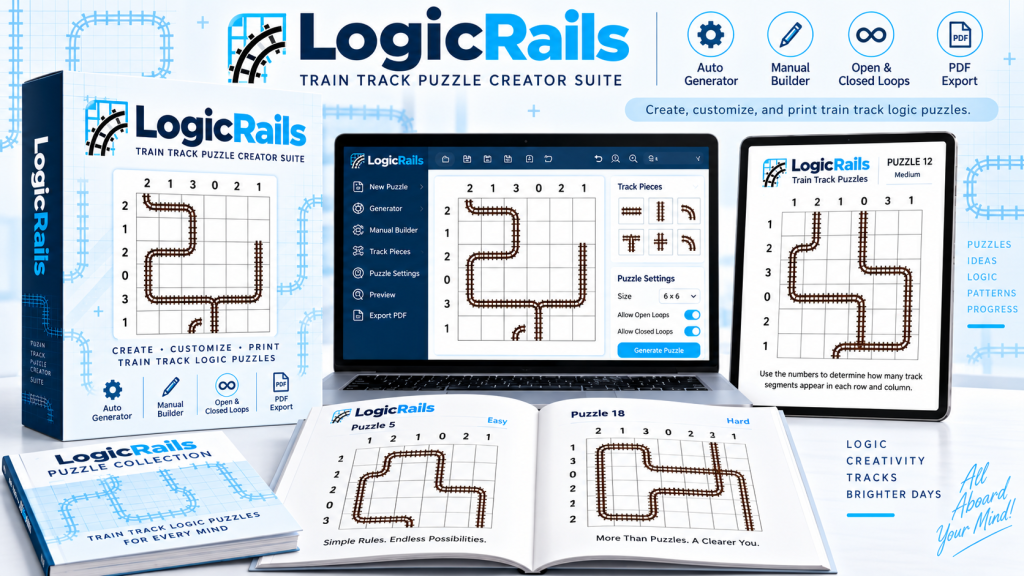
Logic Rails is a browser-based tool that automatically creates Train Track puzzles for people who publish puzzle books, printables and activity content. You open it in your browser, choose your settings, and it builds complete puzzles with the clues already calculated. There's nothing to install, and the vendor states that no API key or tokens are needed.
If you've never played a Train Track puzzle, here's the idea. You get a grid with a few track pieces already placed. Numbers sit beside each row and column, telling you how many squares in that line contain track. Your job is to work out the single continuous railway route that satisfies every number. It's a bit like Sudoku or nonograms in spirit, because you're deducing the answer from clues, but it looks very different on the page. The solution is drawn as an actual railway with rails and sleepers, which gives it a friendly, visual feel.
For a publisher, the interesting part isn't just that the puzzles are fun. It's that making them by hand is tedious. You have to design a valid route, count every row and column, hide some pieces, and then draw the matching solution. One wrong count and the puzzle is unsolvable. Logic Rails automates all of that, which is where the time savings come from.
Who Is Behind It?
Logic Rails is created by Ken Bluttman, a web developer, author and digital product creator who runs his publishing tools under the Innovative Digital Publishing name. His sales page describes him as a product creator with more than $1.5 million in sales, and he's known in the self-publishing community for puzzle-creation software and training on app building and KDP publishing.
That background matters a little. When you're buying a tool from someone who has built similar software before, you're more likely to get something that works as described and has a support channel behind it. It isn't a guarantee of quality, of course, but it's a better starting point than a brand-new vendor with no track record.
==> Get The Full Logic Rails Buying <==
Why Train Track Puzzles? The Niche Opportunity
The pitch behind Logic Rails is simple: stand out by offering something different. Classic puzzle categories are extremely crowded, so a new publisher often struggles to get noticed. A less common format gives you a chance to build a small catalog in a corner of the market where fewer people are publishing.
That logic makes sense, but it's worth thinking it through honestly. A newer format can mean less competition, which is good. It can also mean fewer people searching for it, which is not so good. Shoppers who already know they love Train Track puzzles will find your book easily. Everyone else needs a little introduction, which is why a clear "how to play" page at the front of the book is so helpful.
The vendor's own marketing says the niche is relatively uncommon and encourages buyers to move early before it gets busy. Treat that as an opinion about the market rather than a promise. Nobody can guarantee how a niche will perform, and the sales page itself includes an earnings disclaimer saying it doesn't guarantee sales, rankings or income.
Key Features of Logic Rails
Let's get into what you actually get with the front-end version.
Automatic puzzle generation
This is the heart of the tool. It builds a complete Train Track puzzle, including a valid hidden route, the row and column numbers and the starter pieces. You don't have to check the logic yourself because the clues are generated from the finished route.
Open Route and Closed Loop modes
You can create puzzles where the track enters and exits at the edges of the grid, or puzzles where the route forms one complete loop. Having both is handy because you can mix them inside a single book or split them into separate volumes for variety.
Six grid sizes
The available sizes are 6x6, 7x7, 8x8, 10x10, 12x12 and 15x15. Small grids work well for beginners and younger solvers, while larger ones give experienced puzzle fans something to chew on. That range lets you build a book that gets gradually harder, which readers tend to enjoy.
Built-in trim sizes
The tool supports 6x9, 8x10 and 8.5x11 inch trim sizes, three of the most common choices for paperback puzzle books. Choosing your size up front saves you from resizing grids later.
Batch creation
You can generate up to 100 puzzles at a time. For most books, that's enough to fill the whole interior in one or two runs. The vendor says every puzzle is unique, so you're not publishing the same grids as every other buyer, which helps avoid duplicate-content headaches.
Live clue counts
While designing, the tool shows clue counts as you go. It's a small feature, but it takes a lot of guesswork out of building balanced puzzles.
Clean SVG graphics
The track pieces are drawn as scalable SVG graphics with parallel rails, railroad ties, straight sections and curved corners. Because SVG scales without losing quality, the artwork should stay crisp in print and look sharp in digital downloads. It also drops easily into design programs for your book layout.
Puzzle and solution exports
Each puzzle can be exported along with its full matching solution, as separate files. That makes building the answer section at the back of your book much faster.
Commercial rights
According to the FAQ, puzzles and other content generated with Logic Rails come with full commercial rights, so you can use them in books, printables and print-on-demand products. The wording about personal rights refers to the software and training videos, not your output. As always, read the official terms yourself before you publish.
How Logic Rails Works: Step by Step
Here's what the workflow looks like for a typical user.
• Log in and choose a mode. Pick Open Route or Closed Loop, depending on the kind of puzzle you want.
• Select your grid size and trim size. Match the grid to your book format and your target skill level.
• Adjust the clues. Decide how many starter pieces remain visible. More pieces make a gentler puzzle, fewer make it tougher.
• Generate a batch. Create up to 100 puzzles at once. The tool builds the routes and calculates all the numbers.
• Export the files. Download the puzzles and their matching solutions as SVG files.
• Build your book. Place the files into your layout tool, add a title page, instructions and answer section, then publish.
The generation part is quick. The slower part, as with any puzzle book, is layout: arranging pages, adding headers, numbering and designing the cover. Logic Rails handles the puzzle content, not the whole publishing process, so budget some time for that.
==> Read The Truth Logic Rails Today <==
Logic Rails Pricing and Funnel Breakdown
Logic Rails has a simple three-tier structure. Here are the products and prices, side by side.
|
Product Name |
Price |
|
Logic Rails |
$27.00 |
|
Logic Rails Pro |
$37.00 |
|
Logic Rails Publisher |
$47.00 |
Logic Rails Front End ($27 One-Time)
The base product is the automatic generator described above: Open Route and Closed Loop modes, six grid sizes, three trim sizes, batches of up to 100 puzzles, automatic clues and puzzle-plus-solution exports. For most people starting out, this is all you need to produce a complete puzzle book. It's a one-time payment according to the sales page, and the offer is backed by a 30-day refund guarantee.
Logic Rails Pro ($37 One-Time)
The Pro upgrade is for creators who want more control. Based on the vendor's description of the manual designer, it lets you build puzzles by hand: you place straight and curved track pieces on the grid, move, rotate, swap or erase them until the route looks the way you want, then lock the solution and choose which pieces stay visible as clues. The row and column numbers stay tied to the finished route, and you export the puzzle and the full solution as separate files. Publicly available review coverage also mentions larger grids of up to 24x24 in this tier, which is handy if you want themed shapes or bigger challenge pages. Check the current offer page to confirm exactly what's included before you buy.
Logic Rails Publisher ($47 One-Time)
The Publisher upgrade widens your catalog beyond Train Track. According to review coverage of the launch, it adds three more logic puzzle types: Hashi (also called Bridges), Binary (also called Takuzu) and Shikaku (also called Rectangles). All three are well-known deduction formats, so this tier makes sense if you'd like to create mixed logic puzzle books, bonus sections or separate series alongside your railway titles.
One small caution: different websites label the upgrades slightly differently, and the names in your price list (Pro and Publisher) may not match what other reviewers call them. The prices and general features line up, but always confirm the details on the official checkout page.
Which Version Should You Choose?
The honest answer for most beginners is to start with the front end. Here's how I'd think about it.
Start with the $27 version if...
You're new to puzzle publishing, you want to test the format, or you simply want to see whether Train Track puzzles suit your audience. The core generator can already produce a full book, so there's no need to buy everything on day one.
Add Pro if...
You enjoy designing, want signature or themed layouts, or you'd like extra-large grids. If you're happy with automatically generated puzzles, you can safely skip this and revisit it later.
Add Publisher if...
You'd like to build a broader catalog with several puzzle types. Mixed logic books are a common product in this niche, so the extra formats can help you sell variety. If you only plan to publish Train Track titles, you probably don't need it yet.
A sensible rule: buy an upgrade when you can name the specific problem it solves for you right now. "It might be useful someday" isn't a good enough reason.
What Can You Create With Logic Rails?
The vendor lists several uses, and they're a useful way to think about the tool beyond a single book.
• Puzzle books: The obvious one, usually for Amazon KDP paperbacks.
• Activity books: Mix Train Track pages with colouring, mazes or trivia.
• Printable packs: Sell digital downloads on marketplaces like Etsy.
• Classroom worksheets: Useful for teachers, though the puzzles suit older kids and adults rather than little ones.
• Lead magnets: Offer a free puzzle sheet to grow an email list.
• Membership content and bonuses: Add puzzle packs to a paid community or product bundle.
The vendor says the primary market is Amazon KDP, with Etsy and Teachers Pay Teachers as other options. That flexibility is a genuine plus, because you're not tied to one platform.
==> Click Here to Get Logic Rails + Bonus at a Discount Price <==
The Good: What I Like
• Low price. A $27 one-time front end is easy to try, especially with a 30-day refund guarantee on offer.
• Saves a lot of manual work. Counting rows and columns by hand is exactly the kind of chore software should do.
• Fresh format. Train Track puzzles are less familiar than Sudoku or word search, which can help you stand out.
• Print-friendly graphics. SVG output stays sharp at any size.
• Flexible book setup. Multiple grids, trim sizes and modes make it easy to plan a progressive book.
• No API key or token costs. There are no per-puzzle fees to worry about.
• Commercial rights for your output. You can use what you generate in products you sell.
The Not-So-Good: Things to Consider
• It doesn't build the whole book. You still need layout software, a cover and a listing. Logic Rails only handles the puzzles.
• The format is less familiar. Fewer people know Train Track puzzles, so you may need to explain the rules clearly on the first pages and in your description.
• Upsells exist. There are two upgrades, so the total cost can rise if you buy everything.
• No guaranteed income. The sales page itself says it doesn't guarantee sales, rankings or royalties. Your cover, keywords, pricing and competition all matter.
• Online access required. It's a cloud-based membership site, so you need an internet connection to use it.
• Not for small kids. The vendor says it's fine for older kids and all adults.
Practical Tips for Building a Train Track Puzzle Book
If you decide to try it, a few habits will help you get a better result.
Plan a difficulty curve
Start with small grids and plenty of starter pieces, then gradually raise the challenge. Readers enjoy feeling themselves improve as they move through the book.
Add a clear how-to-play page
This is probably the most important page in the book. Keep the rules to a few short sentences and show one small worked example. A new solver who understands the idea in thirty seconds is far more likely to leave a good review.
Mix Open Route and Closed Loop
Variety keeps solvers engaged. You could also split the modes into two volumes and build a small series.
Test a few puzzles yourself
Even though the clues are calculated automatically, it's smart to solve a handful before you publish. It helps you judge difficulty and catch layout problems.
Invest in the cover and title
A great puzzle set with a dull cover can still struggle. Make the railway theme obvious at a glance, and write a title that tells shoppers exactly what they're getting.
Think beyond one book
The same puzzles can become printable packs, worksheets or lead magnets. Reusing content in several formats is one of the easiest ways to get more from a single tool.
Support, Refunds and Rights
The sales page states a 30-day money-back guarantee and provides a support desk contact. It also says every puzzle is unique and that output comes with commercial rights. These are all reassuring, but terms can change, so read the official page and the terms of service before you pay.
Final Verdict: Is Logic Rails Worth It?
Logic Rails does one job and does it neatly. It takes a slow, error-prone task, designing Train Track puzzles with correct clues, and turns it into a few clicks. For $27 one-time, with a refund guarantee, that's a fairly low-risk way to try a less common puzzle format.
Is it a magic ticket to Amazon royalties? No, and nobody should tell you it is. Your results will depend on your book concept, cover, pricing, keywords and persistence. What the software gives you is speed and variety, and that can be a real advantage if you're serious about building a catalog.
My recommendation is simple. If you publish puzzle books or want to start, grab the front end first, build one short book, and see how readers respond. If you later want hand-built puzzles or extra puzzle types, the Pro and Publisher upgrades are there. Before you buy, double-check the current price, launch window and included features on the official page, since launch offers often change.
Frequently Asked Questions
1. What is Logic Rails?
It's a browser-based tool that generates Train Track logic puzzles, with clues and solutions, for puzzle books and printables.
2. How much does Logic Rails cost?
The front end is $27. Logic Rails Pro is $37 and Logic Rails Publisher is $47, all one-time prices.
3. Do I need design skills or an API key?
No API key or tokens are needed. You'll use a layout tool for your book, but the puzzles themselves are generated for you.
4. Can I sell the puzzles I create?
According to the vendor, yes. Output comes with commercial rights for books, printables and similar products.
5. Does it guarantee sales?
No. The vendor's own disclaimer says results depend on your book, marketing and competition.