Whop Engine Review Can AI Really Build and Launch Your Membership Business in One Click?
Let me guess how this started for you. You have an idea, or at least a niche you care about. You have seen people sell courses, run paid communities, and collect recurring payments every month. And then you start looking into what it actually takes: an offer, pricing, lessons, community posts, a logo, a checkout page, promotion, and some way to track it all. Suddenly the dream feels like a second full-time job.
That is the gap Whop Engine is trying to close. In this Whop Engine Review, I will explain what the software is, what it promises, how the features fit together, what each level of the funnel costs, and who should (and should not) consider buying it. I will keep things simple and honest, because a tool like this deserves a careful look before you spend money.
A quick note on my approach. Everything in this review is based on the official product description and the funnel details provided. I am not going to promise you income or pretend that software can replace effort. What I can do is show you what the tool is designed to do, point out where it looks strong, and flag the parts you should check for yourself before buying.
What Is Whop Engine?
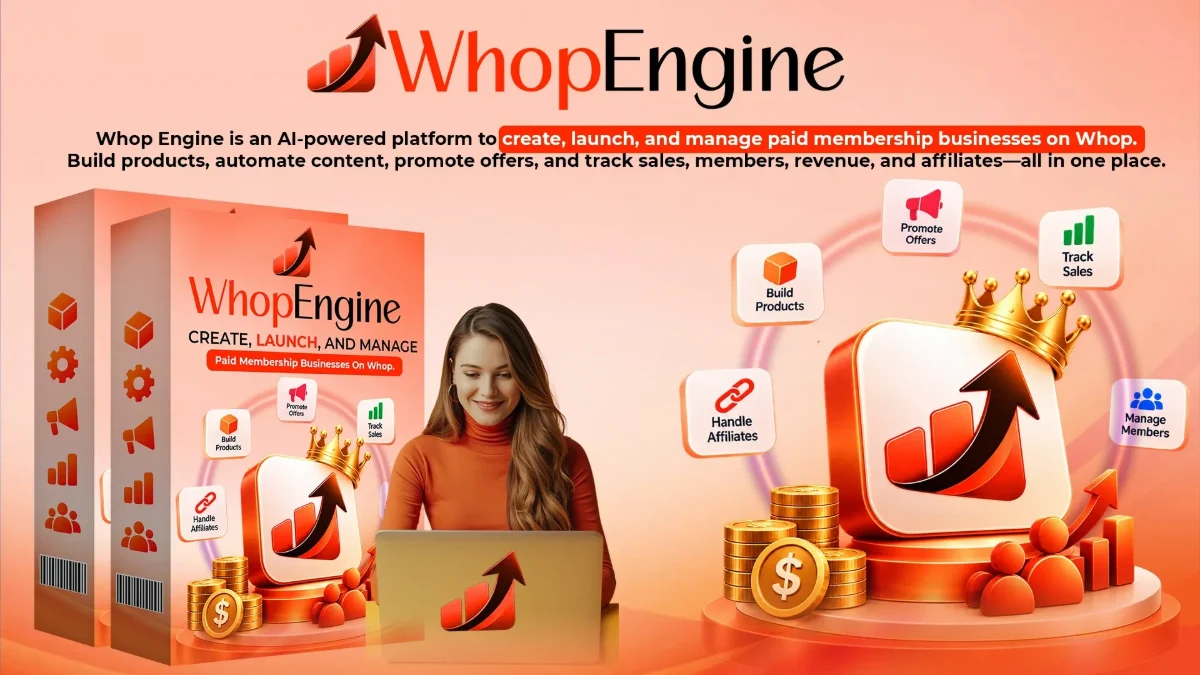
Whop Engine is an AI-powered tool that helps you turn an idea or niche into a fully launched, monetized membership business on Whop. Instead of piecing everything together by hand, you work from one dashboard, and the AI helps create your offer, pricing, courses, community content, branding, promotions, and ongoing content.
According to the product description, the AI can do quite a lot. It can generate business offers and pricing, create courses and community posts, and design logos and store images. It can also launch your Whop store, product, course, community, chat, and checkout link in one click. From there, you can submit your products to Whop Discover, activate an affiliate program, and automate fresh lessons and community posts to keep your members engaged.
The core promise is easy to say out loud: choose your business idea, let AI build and launch your membership offer, automate your content and promotions, and track sales, members, recurring revenue, cancellations, and affiliate sales, all in one place.
A Quick Look at Whop and the Membership Model
To judge Whop Engine fairly, it helps to understand what it is built on.
What is Whop?
Whop is a platform where creators and businesses can sell digital products and memberships. Think of paid communities, online courses, private groups, software access, and similar offers. Because everything is handled in one ecosystem, sellers do not have to connect lots of separate tools just to take a payment and deliver access.
Why memberships are attractive
The appeal of a membership business is recurring revenue. Instead of selling something once and starting from zero again the next month, members pay on a regular basis for as long as they stay. That makes income more predictable and gives you a reason to keep improving your content.
The hidden challenge
Here is the problem. A membership only works if there is steady value inside it. Members expect fresh lessons, active conversations, and a reason to stay subscribed. Owners often burn out because they have to keep producing content and promoting the business at the same time. If you stop, cancellations rise. This ongoing workload is exactly what Whop Engine aims to reduce through automation.
==> Get The Full Whop Engine Buying <==
The Problems Whop Engine Tries to Solve
Let us be specific about the pain points, because they explain why this kind of product exists at all.
• Getting started is confusing. Deciding on an offer, a price, and a structure can freeze people before they even begin.
• Content takes forever. Writing lessons and community posts from scratch is slow, especially for beginners.
• Branding is a hurdle. Many people do not have a logo, store images, or a consistent look.
• Setup has many moving parts. A store, a product, a course, a community, chat, and a checkout link all need to work together.
• Promotion is a constant job. Without promotion, nobody finds your offer.
• Tracking is scattered. Sales, members, cancellations, and affiliate results can end up in different places.
Whop Engine tries to answer each of these from one dashboard. Whether it does so well enough for your needs is the question we will explore below.
How Whop Engine Works, Step by Step
Based on the description, the process looks something like this.
Step 1: Choose your idea or niche
You begin with a business idea or a niche. This is the only part that really has to come from you, and it is worth thinking about carefully. A topic you understand and an audience you can reach will always make the rest easier.
Step 2: Let the AI create your offer and pricing
The AI generates a business offer and pricing structure. This removes one of the biggest early obstacles: figuring out what to sell and how much to charge. You can review what it suggests and adjust it to fit your own vision.
Step 3: Build courses, community content, and branding
Next, the AI creates courses and community posts, and designs a logo and store images. In other words, the content and the look of your business are drafted for you instead of left as a blank page.
Step 4: Launch in one click
With one click, the system launches your Whop store, product, course, community, chat, and checkout link. Normally each of these pieces would be set up one at a time, so bundling them into a single action is a big part of the appeal.
Step 5: Promote and grow
You can submit your products to Whop Discover and activate an affiliate program, so other people can promote your offer and earn from it. These are two ways to bring in traffic without relying only on your own posting.
Step 6: Keep members engaged with automation
To stop your membership from going quiet, you can automate fresh lessons and community posts. Members see regular activity and new material, which supports retention.
Step 7: Track everything
Finally, you track sales, members, recurring revenue, cancellations, and affiliate sales from one dashboard. That gives you a clear view of what is growing and what needs attention.
Whop Engine Features: A Closer Look
AI business offers and pricing
Coming up with a good offer is half the battle. The AI proposes the concept and the pricing, giving you a starting point you can refine. For beginners, this can replace days of second-guessing.
AI-created courses
Courses are a common core of paid memberships. Having the AI generate course content gives you a first draft quickly. I would still recommend reading it carefully and adding your own examples and experience, because personal insight is what makes people trust you.
AI community posts
A quiet community is a dying community. The AI can create community posts to get conversations started and keep the space active. Used well, this can help new members feel that something is happening from day one.
Logos and store images
The AI designs logos and store images, which helps your business look professional without hiring a designer. First impressions matter, especially when someone is deciding whether to pay for a membership.
One-click launch
This is the headline feature. A single click launches the store, product, course, community, chat, and checkout link. For people who feel overwhelmed by technical setup, that simplicity is the main selling point.
Whop Discover submission
You can submit your products to Whop Discover, which is a way to get your offer in front of more people on the platform. Exposure is one of the hardest things for a new seller, so any built-in route to visibility is useful.
Affiliate program activation
Activating an affiliate program lets others promote your products for a commission. This can multiply your reach without requiring you to do all the marketing yourself. It also gives you affiliate sales to track in the dashboard.
Automated lessons and community posts
Automation keeps your membership fresh. Rather than scrambling to produce something every week, you can have new lessons and posts scheduled to appear. That consistency is key to keeping members subscribed.
One dashboard for tracking
The dashboard shows sales, members, recurring revenue, cancellations, and affiliate sales. Seeing cancellations next to revenue is especially helpful, because it tells you whether your content is keeping people around.
==> Read The Truth Whop Engine Today <==
The Whop Engine Funnel and Pricing
Now for the part many readers jump to first: the cost. Whop Engine has a front-end offer, an order bump, six upsells (OTOs), and a downsell for each one. Here is the full picture.
|
Stage |
Product |
Price |
Downsell |
|
FE |
Whop Engine |
$14 |
- |
|
Bump |
Whop Engine Special |
$24 |
- |
|
OTO 1 |
Whop Engine Profit |
$47 |
$37 |
|
OTO 2 |
Whop Engine Scale |
$67 |
$47 |
|
OTO 3 |
Whop Engine Automation |
$47 |
$42 |
|
OTO 4 |
Whop Engine DFY |
$97 |
$67 |
|
OTO 5 |
Whop Engine Traffic |
$67 |
$47 |
|
OTO 6 |
Whop Engine Business Box |
$197 |
$147 |
One important point: the funnel details I have list the product names and prices, but they do not spell out exactly what every upsell contains. So for several levels below, I will describe what the name suggests and tell you plainly when something needs to be confirmed on the official sales page before you buy.
Front End: Whop Engine ($14)
The front end costs $14. This is the core Whop Engine software described earlier, the part that turns your idea into a launched membership business with AI-created offers, content, branding, and a one-click launch. At this price, the barrier to trying it is very low, which I like.
Order Bump: Whop Engine Special ($24)
At checkout, there is a bump offer called Whop Engine Special at $24. Bumps are small add-ons presented right on the order page. Since the specific contents are not listed in the funnel information I have, check the checkout page to see exactly what it adds before ticking the box.
OTO 1: Whop Engine Profit ($47, Downsell $37)
The first upsell is Whop Engine Profit at $47. Going by the name, it is aimed at the earning side of your business. If you pass on it, a downsell of $37 is offered. Look at the sales page to see which profit-related features are included and whether they are things you need right now.
OTO 2: Whop Engine Scale ($67, Downsell $47)
The second upsell is Whop Engine Scale at $67, with a $47 downsell. The name suggests growth, meaning handling more members, more products, or a bigger operation. If you are still at the idea stage, this is usually something you can add later, once you have real members to scale.
OTO 3: Whop Engine Automation ($47, Downsell $42)
Next comes Whop Engine Automation at $47, with a downsell at $42. The core software already includes some automation for lessons and community posts, so look closely at what extra automation this upgrade adds. If your goal is to run your membership with minimal daily effort, this could be worth a closer look.
OTO 4: Whop Engine DFY ($97, Downsell $67)
The fourth upsell is Whop Engine DFY at $97, with a $67 downsell. DFY normally means done for you. This type of upgrade is typically for people who want less hands-on work and more ready-made results. Confirm exactly what is delivered, because done-for-you packages vary a lot from one product to another.
OTO 5: Whop Engine Traffic ($67, Downsell $47)
The fifth upsell is Whop Engine Traffic at $67, with a $47 downsell. Traffic is the lifeblood of any membership business. A product with no visitors earns nothing, so a package focused on getting people to your offer can be valuable. As always, check the details to see what methods it covers and whether they suit you.
OTO 6: Whop Engine Business Box ($197, Downsell $147)
The final upsell is Whop Engine Business Box at $197, with a $147 downsell. It is the most expensive item in the funnel, so it deserves the most scrutiny. Read the full description, understand what you get, and ask yourself whether you would use it within the next few months. If you are not sure, skip it for now.
Understanding the Downsells
Every upsell in this funnel has a lower-priced downsell, which appears if you decline the main offer. The pattern is clear in the pricing: OTO 1 drops from $47 to $37, OTO 2 from $67 to $47, OTO 3 from $47 to $42, OTO 4 from $97 to $67, OTO 5 from $67 to $47, and OTO 6 from $197 to $147.
Two things are worth knowing. First, downsells usually offer a reduced version of the same product, so be sure to read what is cut. Second, a lower price is only a bargain if you actually need the product. Do not let a discount convince you to buy something you will never open.
For the numbers, here is the quick math. If you bought all six OTOs at full price, they would total $522, and adding the $14 front end brings it to $536. Buying every downsell instead would cost $387 for the OTOs alone. Very few people will need everything, so a staged approach makes more sense.
Which Whop Engine Option Should You Choose?
Because there are so many levels, a simple guide will help. Here is how I would think about it.
• Just exploring: buy the front end for $14 and test the core workflow. Do not add anything else yet.
• Want a smoother launch: consider the order bump after reading what it includes.
• Already have members and want to grow: look at Scale (OTO 2) and Traffic (OTO 5).
• Want to reduce daily workload: look at Automation (OTO 3) and DFY (OTO 4).
• Want a bigger business setup: consider Business Box (OTO 6), but only after reading the details and being sure you will use it.
My general advice is to start with the front end. Launch something small, see how the dashboard and the AI output feel, and then decide on upgrades based on real needs. This way you pay only for what helps.
==> Click Here to Get Whop Engine + Bonus at a Discount Price <==
Who Is Whop Engine Best For?
Beginners who feel stuck at the start
If you have been staring at a blank page, unsure what to sell or how to price it, the AI-generated offer and pricing can give you a push. The one-click launch also removes the technical fear that stops many people.
Creators and coaches
If you already have knowledge to share, a paid membership is a natural way to monetize it. The AI can help structure courses and community content so you can focus on your expertise.
Affiliate marketers and digital sellers
The built-in affiliate program feature and Whop Discover submission make this tool interesting for people who think in terms of promotion and traffic. You can create your own offer and also let others promote it.
Agencies and freelancers
Anyone who builds digital businesses for others may find the speed useful. Being able to set up a store, course, and community quickly can shorten delivery times, though you should confirm licensing and usage rights on the official page if you plan to use it for clients.
Who might want to skip it
If you want guaranteed income without effort, no tool will give you that. If you already have a polished membership setup with a custom workflow, you may not need what Whop Engine offers. And if you do not want to build an audience at all, remember that even the best-built store will not sell without visitors.
Whop Engine Pros and Cons
Pros
• Very low starting price. The front end is only $14, so testing costs little.
• One-click launch. Store, product, course, community, chat, and checkout link are launched together.
• AI handles the heavy content work. Offers, pricing, courses, posts, logos, and store images are all drafted for you.
• Built-in growth options. Whop Discover submission and an affiliate program are part of the system.
• Automation for retention. Fresh lessons and community posts can be scheduled to keep members engaged.
• Clear tracking. One dashboard for sales, members, recurring revenue, cancellations, and affiliate sales.
• Staged funnel. You can buy only the upgrades you need.
Cons
• Many upsells. A bump, six OTOs, and six downsells can feel heavy at checkout.
• Upsell details are unclear. Several level names do not explain exactly what they include, so you need to read the sales page.
• AI content needs review. Generic output will not stand out unless you add your own voice.
• Traffic is still your job. A launched store does not bring buyers by itself.
• Results are not guaranteed. Membership income depends on your niche, offer quality, and effort.
Making Whop Engine Work in the Real World
Software can launch a business. It cannot make people care about it. Here are some practical habits that will improve your chances.
Pick a niche you can serve well
Choose a topic where you can genuinely help people, and where there is a group of buyers who already spend money. A narrow, clear promise usually beats a broad, vague one.
Edit the AI output
Treat the generated offer, lessons, and posts as a first draft. Add your own stories, examples, and opinions. Members pay for value and personality, not for generic text.
Check the pricing against your audience
Look at the pricing the AI suggests and ask whether it fits the people you plan to serve. You can adjust it as you learn more about your market.
Show up in the community
Automated posts help, but real conversations keep people subscribed. Reply to members, ask questions, and listen to feedback. A community with a visible, friendly host feels very different from one that looks automated.
Use the affiliate program early
Activating the affiliate program gives other people a reason to promote you. Consider reaching out to a few friendly creators or marketers in your niche and inviting them to try it.
Watch the dashboard
Check cancellations as often as sales. If many people leave after the first month, the issue may be your content or onboarding, not your marketing. The dashboard makes this visible, so use it.
Be honest in your promotion
Describe what members will really get, avoid exaggerated promises, and follow the rules of the platforms where you advertise. Honest marketing builds trust, and trust keeps memberships alive.
Common Mistakes New Membership Owners Make
Even with a smart tool, certain mistakes show up again and again. Knowing them in advance can save you a lot of frustration.
Launching without a clear promise
If a visitor cannot understand in a few seconds what they will get, they will leave. Whatever the AI generates, make sure your main promise is simple and specific. "Learn to do X in Y weeks" is far stronger than a vague description.
Setting the price without thinking about retention
A low price may bring signups, but it does not automatically bring happy members. A higher price can attract more serious people. Test, listen, and adjust. The dashboard numbers on cancellations will tell you if you got it wrong.
Letting the community go silent
Automated posts are useful, but they are not a substitute for you. Members notice when nobody answers their questions. A few minutes of real interaction each day makes a big difference.
Expecting traffic to appear on its own
One-click launching is exciting, but it only creates the storefront. You still need to tell people it exists. Use Whop Discover, the affiliate program, content, and your own network to bring visitors in.
Buying every upsell on day one
The funnel is built to make upgrades look attractive, and some of them may truly help. But buying everything before you have launched a single product is a common way to overspend. Wait until you have a real need.
Is the One-Click Launch Too Good to Be True?
It is a fair question. Any time a product promises to launch a whole business with one click, a bit of skepticism is healthy.
Here is how I would look at it. The one-click launch is a setup shortcut, not a success guarantee. It saves you from the technical steps of creating a store, a product, a course, a community, a chat, and a checkout link separately. That is real time saved, especially for beginners. But a launched business is only the starting line. The quality of your offer, the care you put into your content, and your ability to attract members are what decide whether it grows.
In that sense, Whop Engine is best seen as a very fast way to get to the part that matters: talking to real people, learning what they want, and improving your offer. If you use the speed to start earlier and learn faster, it can be valuable. If you expect the click to do all the work, you will probably be disappointed.
If you are unsure where to begin, try a simple experiment. Launch one small membership around one narrow topic, invite a handful of people, and collect their feedback in the first two weeks. Use what you learn to improve the lessons, tweak the price, and decide whether any of the upgrades would genuinely help. That small loop of launching, listening, and improving will teach you more than any amount of planning.
Whop Engine vs Building a Membership Business Manually
The traditional route goes like this. You research your niche, write an offer, set pricing, build a course, write posts, design a logo, set up a store, connect payments, create a community, then figure out promotion and tracking. Each step involves a different tool or skill, and the whole process can take weeks.
With Whop Engine, much of that is compressed. The AI drafts the offer, pricing, courses, posts, and branding, the one-click launch creates the setup, and the dashboard tracks the results. You still choose the idea and shape the final product, but you skip a lot of repetitive work.
The trade-off is control and originality. A hand-built business can be shaped exactly to your taste, while an AI-built one needs more editing to feel personal. For many people, especially beginners, starting fast and refining later is the better path.
Whop Engine Review: Final Verdict
So, is Whop Engine worth it? Here is my honest conclusion.
For $14, the front end is an easy product to try. It takes the most intimidating parts of starting a membership business, such as the offer, pricing, content, branding, and setup, and hands you an AI-built first draft with a one-click launch. The addition of Whop Discover submission, an affiliate program, automated content, and a single tracking dashboard makes it feel like a complete workflow rather than a single gimmick.
The upsells are where you need to be careful. With a bump, six OTOs, and six downsells, it is easy to overspend. Since the funnel details do not fully explain every upgrade, read each description closely and buy only what solves a problem you actually have. Start with the front end, build something small, and let your own results guide your next purchase.
Above all, remember that a membership business grows through value and consistency. Whop Engine can help you launch faster and stay active with less effort, but the audience, the promise, and the care are still yours to bring. If you are ready to do that, this tool could be a very useful shortcut.
Whop Engine Review: Frequently Asked Questions
Q: What is Whop Engine?
Whop Engine is an AI tool that builds and launches a paid membership business on Whop from one dashboard.
Q: How much does Whop Engine cost?
The front end costs $14, with an optional $24 order bump and six upsells.
Q: Does it launch everything automatically?
Yes. One click launches your store, product, course, community, chat, and checkout link.
Q: Can I promote my products with it?
Yes. You can submit products to Whop Discover and activate an affiliate program.
Q: Does Whop Engine guarantee income?
No. It speeds up setup, but sales depend on your niche, offer, and promotion.