ProductsPilot Review Is This AI Product Creator Worth $37? (Full Funnel Breakdown and Honest Verdict)
Disclosure: this article contains affiliate links. If you buy through them, I may earn a commission at no extra cost to you. This review is based on the official offer structure and pricing as listed at the time of writing, not on a long-term hands-on test, so please treat it as a buyer's guide rather than a results report.
Every few months a new tool shows up promising to make selling digital and print-on-demand products almost effortless. Most of them lean on the same pitch: type a prompt, press a button, watch products appear. Some deliver a little of that. Many deliver a lot less. So when ProductsPilot landed on my radar, my first reaction was cautious curiosity rather than excitement.
This ProductsPilot review goes through the offer the way a careful buyer would. We'll look at what the tool is supposed to do, what the front-end package includes, how the upsell funnel is laid out, what every upgrade costs, and who is likely to get real value from it. I'll also be blunt about the parts that deserve a second look before you hand over any money.
If you only want the short version, here it is. ProductsPilot has a low entry price, a clear product-creation focus, and a funnel with plenty of optional upgrades. The entry version looks reasonable for beginners who want to test the idea. The higher tiers make sense only if you already know you'll use the volume. Skip the upsell stack until the basic version has earned your trust.
What Is ProductsPilot?
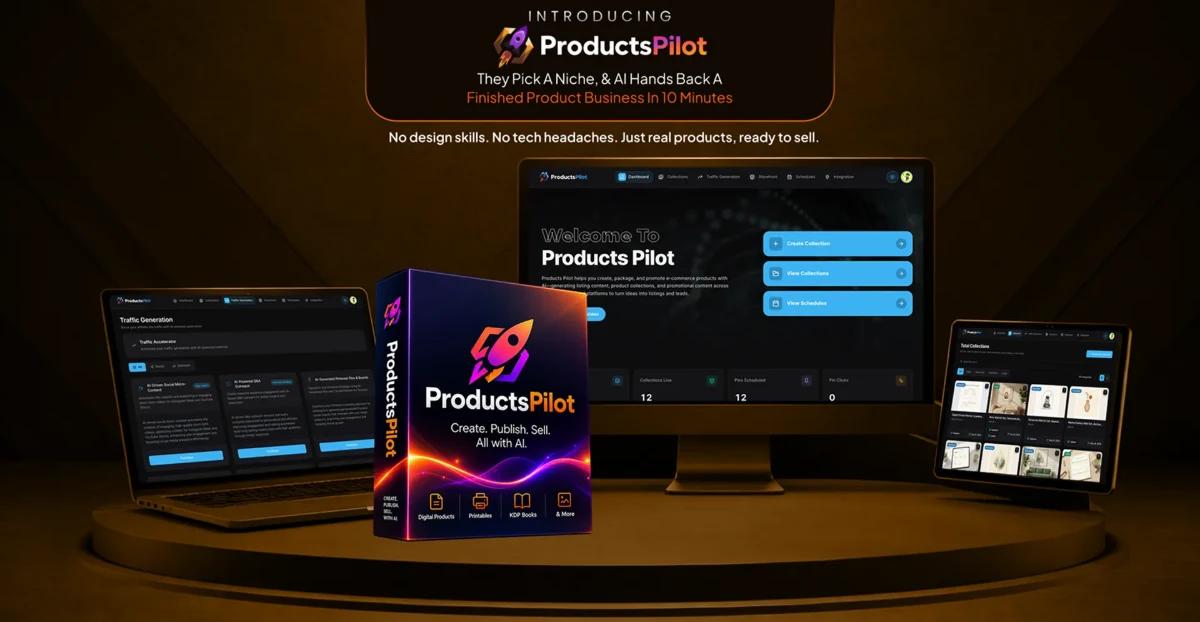
ProductsPilot is an AI-powered platform built to help you create sellable products and get them in front of buyers. It is not a single gadget that does one trick. It's a package of AI agents, product formats, storefront options and marketplace tools, sold through a main front-end offer and a series of optional upgrades.
The idea behind tools like this is simple. Creating products by hand takes time, and time is the thing most beginners run out of first. You need an idea, a design or document, a listing, a description, a place to sell it, and then you have to repeat the whole thing again. If an AI system can handle a decent chunk of that work, you can test more ideas in less time and keep the ones that actually sell.
The front-end version, according to the offer details, gives you four AI agents, eight product types, up to fifteen products per month and two shops. That sounds modest next to the bigger tiers, and that is on purpose. It's built to get you through the door at $37, with the price listed as rising, and then show you what more you could unlock.
How ProductsPilot Works
The vendor describes the system as a set of four AI agents working together. I won't pretend to know the exact job titles of each agent, because that's best confirmed on the official page. What I can tell you is how this kind of workflow normally runs, and it helps to understand it before you buy anything.
First, you choose what you want to make. That might be a certain niche, a style, or one of the supported product types. Second, the AI generates the product itself, whether that's a design, a printable, a low-content book interior or something similar. Third, the product gets packaged with a title, description and the other details a marketplace expects. Finally, it's published to a shop or marketplace where buyers can find it.
The big promise is speed. Instead of spending a weekend on a single product, you could in theory produce several in an afternoon. The big caveat is quality. AI can make things quickly, but it can't guarantee that anyone wants them. That part still depends on you picking decent niches and checking what's already selling.
One more thing worth saying plainly: a tool like this removes production effort, not market risk. You can have fifteen beautifully formatted products and still make zero sales if nobody is searching for them. Keep that in mind as we go through the numbers.
What You Get With the Front-End Offer
The entry-level ProductsPilot package is the part most people will actually buy, so it deserves a close look. At $37, the listed inclusions are:
• Four AI agents that handle the creation workflow
• Eight product types to choose from
• A cap of fifteen products per month
• Two shops to publish and manage your products
Let's talk about what each of those numbers really means for you.
Four AI Agents
Having several agents rather than one general-purpose assistant usually means the work is split into stages. That can make output more consistent, since each agent focuses on a narrower task. Whether the results are good enough for your standards is something only a test run can tell you.
Eight Product Types
Variety matters here. If a tool only produces one kind of product, you're betting everything on that one format. Eight types give you room to experiment and find what sells in your chosen niche. It also lets you build a small catalog rather than a single product line.
Fifteen Products Per Month
Fifteen a month is enough to learn from. If you publish fifteen products and study which ones get views, favorites or sales, you'll quickly get a sense of what works. It's not enough if you want to flood a marketplace, which is exactly where the Unlimited upgrade comes in.
Two Shops
Two shops let you split your efforts, perhaps by niche or by platform. For a beginner that's plenty. Agencies and anyone running multiple brands will hit that ceiling fast, which is why one of the upgrades is aimed squarely at them.
Who Is ProductsPilot Best For?
Based on the structure of the offer, ProductsPilot looks most useful for a few types of people.
Beginners who want to test the product-selling model. If you've been curious about selling digital or print-on-demand products but never knew where to start, a $37 entry point is a low-risk way to try. You aren't committing hundreds of dollars before you know whether you enjoy the work.
Side hustlers short on time. If you have a job and only a few spare hours a week, anything that cuts production time is helpful. The monthly cap of fifteen is realistic for someone working evenings.
Existing sellers who want to speed up. If you already sell on a marketplace and spend too long creating each item, an AI workflow could free up time for research and marketing, which is usually where the money is made.
Freelancers and small agencies. The higher tiers, with multiple shops, white-label options and client reporting, are clearly aimed at people who want to offer product creation as a service.
Who Should Probably Skip It?
No tool is for everyone, and pretending otherwise wouldn't be honest.
If you expect to push a button and wake up to sales, you'll likely be disappointed. Nothing in this category works that way. Selling products online takes research, patience and a willingness to adjust.
If you're on a very tight budget and the $37 would genuinely hurt, wait. There are free ways to learn the basics of marketplace selling first, and you can always come back.
And if you already have a polished, well-tuned workflow that produces good results, an AI tool may add little. It's most valuable when you're starting out or when production is your bottleneck.
The Full ProductsPilot Funnel and Pricing
This is the part many reviews gloss over, and it's the part that matters most to your wallet. ProductsPilot has a main offer followed by a series of upgrades, bundles and an order bump. Here's the whole picture laid out in one place.
|
PRODUCT |
PRICE |
|
FE: ProductsPilot (4 AI agents, 8 product types, 15 products/mo, 2 shops) |
$37 (rising) |
|
FastPass (all 4 upgrades + 3 bonus app licences + all bonuses, right after FE) |
$230/year |
|
Gold DFY Vault (500 finished products — FastPass, Bundle & Lifetime buyers ONLY) |
$197 |
|
OTO1: Unlimited (unlimited products + premium engine + bulk + API) |
$67/year |
|
OTO2: Diamond Storefront (branded shop, buyer capture, no marketplace cut) |
$97/year |
|
OTO3: Platinum Agency (25 shops, white-label, client reports, team access) |
$97 |
|
OTO4: Elite Marketplace Multiplier (KDP low-content + 7 more marketplaces) |
$67/year |
|
Bundle Deal (direct link, see what's included below). Use coupon code "pilot" for $50 off at the cart |
$317/year |
|
Lifetime Bundle (direct link, one payment, never renews) |
$497 |
|
MegaBundle (order bump on the bundle pages) |
$127 |
|
MAX PER CUSTOMER |
$771 |
The listed maximum per customer is $771. That's the ceiling if you were to say yes to everything on offer. Almost nobody needs to, and I'll explain why in a moment.
Notice something in the table: several items are billed per year rather than as a one-off payment. That's easy to overlook when you're excited at checkout, so always check whether a price is a one-time fee or recurring before you click buy.
Breaking Down Each Upgrade
FastPass ($230 per year)
FastPass bundles all four of the main upgrades, three bonus app licences and the available bonuses, and it's offered right after the front-end purchase. Buying the four upgrades separately would cost $67 + $97 + $97 + $67, which adds up to $328, so FastPass is roughly $98 cheaper on paper. One caution: in the table one of those four upgrades is shown without a yearly label, so confirm exactly how each part is billed on the checkout page.
FastPass also unlocks access to the Gold DFY Vault, which brings us to the next item.
Gold DFY Vault ($197)
DFY means done for you. This is a collection of 500 finished products that you can use without creating them yourself. It's only available to FastPass, Bundle and Lifetime buyers, so you can't buy it on top of the front-end alone.
The appeal is obvious: a ready-made library saves a lot of time. The concern is also obvious. If many other buyers publish the same ready-made products, you may end up competing with identical listings. If you do buy it, plan to customize what you use instead of publishing everything as-is.
OTO1: Unlimited ($67 per year)
This upgrade removes the fifteen-per-month cap and adds a premium engine, bulk creation and API access. It makes the most sense after you've proven that your products sell and the cap is actually holding you back. Buying unlimited volume before you have a winning niche is just a faster way to create unsold inventory.
OTO2: Diamond Storefront ($97 per year)
This gives you a branded shop, buyer capture and, importantly, no marketplace cut. On a normal marketplace, the platform takes a slice of every sale and owns the customer relationship. Your own storefront lets you keep more of each sale and collect buyer details for future marketing.
That sounds great, and it can be, but there's a catch: a branded shop needs its own traffic. Marketplaces bring built-in shoppers. A private storefront does not. If you don't plan to drive visitors yourself, this one can wait.
OTO3: Platinum Agency ($97)
With twenty-five shops, white-label options, client reports and team access, this is built for people who plan to run ProductsPilot for other businesses. If you're just selling your own products, you can safely ignore it. If you want to offer product creation as a service, it's the upgrade that turns the tool into a small business model.
OTO4: Elite Marketplace Multiplier ($67 per year)
This one adds Amazon KDP low-content support plus seven more marketplaces. Low-content books are things like journals, planners and notebooks that need little actual text. Spreading across several marketplaces can widen your reach, though every extra platform means extra rules to learn and keep up with.
Bundle Deal ($317 per year)
The Bundle is a direct-link offer with a coupon: use the code "pilot" at the cart to take $50 off. That brings the price down to $267. It's worth noting that $267 is the same as the front-end plus FastPass ($37 + $230), so check carefully what the Bundle includes beyond that. One clear difference is that Bundle buyers are eligible for the Gold DFY Vault.
Lifetime Bundle ($497)
One payment, never renews. For anyone who is certain they'll use ProductsPilot for years, this is the cleanest option, since you avoid the yearly fees stacking up. But "lifetime" always deserves a sensible question: lifetime of what? Read the terms so you understand exactly what stays included and for how long.
MegaBundle ($127 order bump)
This is shown as an order bump on the bundle pages, meaning it appears as a tick-box add-on at checkout. Order bumps are designed to be easy to say yes to. Read what you're adding before you tick it, especially since I can't verify from the table alone what it contains.
Which Package Should You Actually Buy?
With this many options, the real question isn't what ProductsPilot can do. It's what you should pay for. Here's a practical way to think about it.
If You're a Complete Beginner
Start with the front-end at $37 and nothing else. Use it for a month. Create your fifteen products, publish them in your two shops, and watch what happens. You'll learn more from that month than from any sales page, and you'll spend very little.
If You've Sold Online Before
Begin with the front-end too, but think about whether one targeted upgrade fits your situation. If you hit the monthly cap quickly, Unlimited is the logical next step. If you want to build your own brand, look at the Diamond Storefront. Add things one at a time as you actually need them.
If You Want to Serve Clients
The Platinum Agency tier is the one built for you. Before buying it, make sure you have a plan for finding clients, because the software won't find them for you. Treat it as a tool for an existing service, not a replacement for sales.
If You're All-In
If you already know you'll commit seriously, the bundles can make financial sense. The Bundle with the "pilot" coupon or the Lifetime Bundle both reduce the sting of paying for upgrades one by one. The Lifetime option is attractive mainly because it avoids ongoing yearly charges.
In every case, the golden rule is the same: don't buy the whole funnel on day one. Prove the basics first.
ProductsPilot Pros and Cons
What I Like
• The entry price of $37 is low enough to test without much risk.
• A mix of eight product types gives you room to experiment.
• The funnel is layered, so you can buy only what you need.
• Options exist for both solo sellers and agencies.
• A no-marketplace-cut storefront helps you keep more of your margin.
• The Lifetime Bundle removes recurring fees for committed users.
What Gives Me Pause
• The $37 price is described as rising, so it won't stay this low.
• Many items are billed yearly, and the total cost can climb quickly.
• The maximum spend of $771 is a lot for someone just starting out.
• Ready-made products in the Gold Vault could lead to duplicate listings across buyers.
• AI output still needs a human eye for quality, originality and marketplace rules.
• Nothing here guarantees sales. Traffic and niche choice still decide the result.
How Much Could You Realistically Spend?
Because the funnel has so many steps, it helps to see a few realistic budgets side by side. These are simple sums based on the listed prices, so double-check the final figures at checkout.
The cautious starter: $37. Front-end only. You get the core tool, fifteen products a month and two shops. This is where I'd suggest most newcomers begin.
The growing seller: $104. That's the front-end plus the Unlimited upgrade at $67 per year. It fits someone who has already seen early sales and wants to publish more than fifteen products a month.
The serious builder: $267. Either the front-end plus FastPass ($37 + $230) or the Bundle Deal after the "pilot" coupon lands you in the same place. Add the Gold DFY Vault at $197 and you reach $464, with the vault available to FastPass, Bundle and Lifetime buyers.
The long-term commitment: $497. The Lifetime Bundle is a single payment that never renews. Over several years it may work out cheaper than paying yearly fees, as long as you really do keep using the tool.
The everything package: $771. This is the listed maximum per customer. It's there if you want it, but for the vast majority of people it's far more than they need at the start.
Seeing the numbers laid out like this makes one thing obvious. The gap between $37 and $771 is huge, and the smartest move is usually to stay near the low end until your results justify moving up.
Common Mistakes to Avoid
Whatever tool you use, the same handful of mistakes trip up new sellers again and again. Knowing them in advance can save you money and frustration.
Buying every upgrade at once. The excitement of a launch makes it tempting to click yes on everything. Resist it. Each upgrade is easier to justify after you've used the basic version.
Publishing without checking the market. Creating a product nobody searches for is wasted effort, no matter how fast the AI made it. A few minutes of research per product pays off many times over.
Ignoring marketplace rules. Every platform has policies on quality, originality and AI content. Breaking them can get listings removed or accounts restricted. Read the rules first.
Copying ready-made products unchanged. If hundreds of buyers publish the same finished products, none of them stands out. Adjust designs, titles and descriptions so your listings are genuinely yours.
Giving up too early. Results rarely show up in the first week. Most sellers need a few months of steady publishing and tweaking before patterns appear.
Forgetting the recurring costs. With several yearly charges in the funnel, the cost can quietly creep up. Write down what renews and when, so there are no surprises.
A Quick Word on Low-Content Products and Print on Demand
The fourth upgrade mentions Amazon KDP low-content books, so it's worth explaining what that means for anyone new to the idea. Low-content books are items such as journals, planners, notebooks and logbooks. They contain mostly structure, like lines, grids or prompts, rather than long written text, which makes them quicker to produce than a normal book.
They're popular with beginners for exactly that reason. The catch is that they are also popular with everyone else. Competition is strong, and standing out takes good niche selection and tidy presentation. Think about who the book is for, what problem it solves, and why someone would pick yours over the hundreds of similar ones.
Print on demand works on a similar principle. You upload a design, the platform handles printing and shipping when someone orders, and you don't hold stock. It lowers the financial risk, but it doesn't remove the need for good designs and good targeting.
Setting Realistic Expectations
Let's talk honestly about results, because this is where many buyers get let down. A product creation tool can make you faster. It cannot make buyers appear.
Selling products online is a numbers game combined with a research game. You publish, you observe, you adjust. Some products will flop, and a few might do well. The seller who succeeds is usually the one who keeps testing for months, not the one who published once and waited.
If you decide to try ProductsPilot, a sensible goal for the first ninety days is learning rather than earning. Aim to understand which niches get attention, which product types suit you, and how the marketplaces treat your listings. If sales arrive along the way, wonderful. If they come slowly, you'll at least have built a foundation.
There's another point worth stressing. Marketplaces have their own rules about AI-generated content, originality and quality. Those rules change over time. Before you publish anything at volume, read the current policy of every platform you use, and make sure your products comply. A fast tool that gets your account flagged is no bargain.
Tips for Getting the Most Out of ProductsPilot
If you do pick it up, these habits will help you get better results from any AI product tool.
Research before you create. Spend time looking at what already sells in your niche. Look at the competition, the pricing and the gaps. Then use the AI to fill those gaps rather than copying what's there.
Edit what the AI gives you. Treat generated products as a first draft. Small personal touches in design, wording and presentation make a listing stand out from the sea of identical ones.
Start narrow. Pick one niche and build a small collection of related products. A focused shop looks more trustworthy than a random pile of unrelated items.
Track what happens. Keep a simple note of what you published and how each product performed. After a month you'll see clear patterns, and that's where the real learning happens.
Upgrade only when you hit a limit. If you reach the monthly cap and you're still seeing sales, that's a signal to unlock more. If you aren't hitting the cap, you don't need the upgrade.
Is ProductsPilot Better Than Doing It Manually?
It depends on what you value. Doing everything by hand gives you total control and, often, more original work. It also takes much longer, and many beginners give up before they publish enough to learn anything.
An AI-driven tool trades some control for speed. For people who struggle with design or who simply don't have time, that trade can be worth it. For people who enjoy the creative process and already have the skills, it may feel like overkill.
The best approach for many sellers is a mix. Use AI to produce the bulk of the groundwork, then add your own judgment and polish. That way you keep the speed without sacrificing the personality that makes your shop memorable.
Final Verdict: Should You Buy ProductsPilot?
After going through the whole offer, my view is balanced. ProductsPilot is a reasonably priced entry into AI-assisted product creation, with a funnel that gives you plenty of room to grow if things go well.
The front-end at $37 is the sensible way in. It gives you four AI agents, eight product types, fifteen products a month and two shops, which is enough to run a real test. For a beginner or a time-poor seller, that's a fair deal at that price.
The upgrades are where you need discipline. Each one solves a real problem for a specific type of user, but none of them is necessary on day one. The total of $771 is a ceiling, not a recommendation. Buy one step at a time, and only when you have evidence that you need it.
If you want the simplest long-term option and you're confident you'll stick with it, the Lifetime Bundle at $497 avoids recurring fees. If you prefer a gentler start, begin with the entry offer and the "pilot" coupon on the Bundle can be considered later.
As always, no tool replaces effort. ProductsPilot can speed up the making. The choosing, testing and improving are still up to you. Go in with realistic expectations, start small, and you'll give yourself the best chance of making it pay off.
Ready to take a look at the current offer? You can check the latest details and pricing here: Get ProductsPilot here.
ProductsPilot FAQs
What is ProductsPilot?
It's an AI-powered platform for creating and selling products, with four AI agents, eight product types and shop options, sold as a front-end offer plus optional upgrades.
How much does ProductsPilot cost?
The front-end is listed at $37, and that price is described as rising. Upgrades range from $67 to $497, and the maximum total per customer is $771.
Is there a discount code?
Yes. The Bundle Deal lists the coupon code "pilot" for $50 off at the cart.
Do I need to buy the upgrades?
No. The front-end works on its own. Upgrades add volume, storefronts, agency features and more marketplaces, so buy them only if you need them.
Will ProductsPilot guarantee sales?
No tool can. It speeds up product creation, but your niche choice, quality and traffic decide the results.