FableForge Review Is This AI Storybook Tool Really Worth $17? (Honest Look at Every Upgrade)
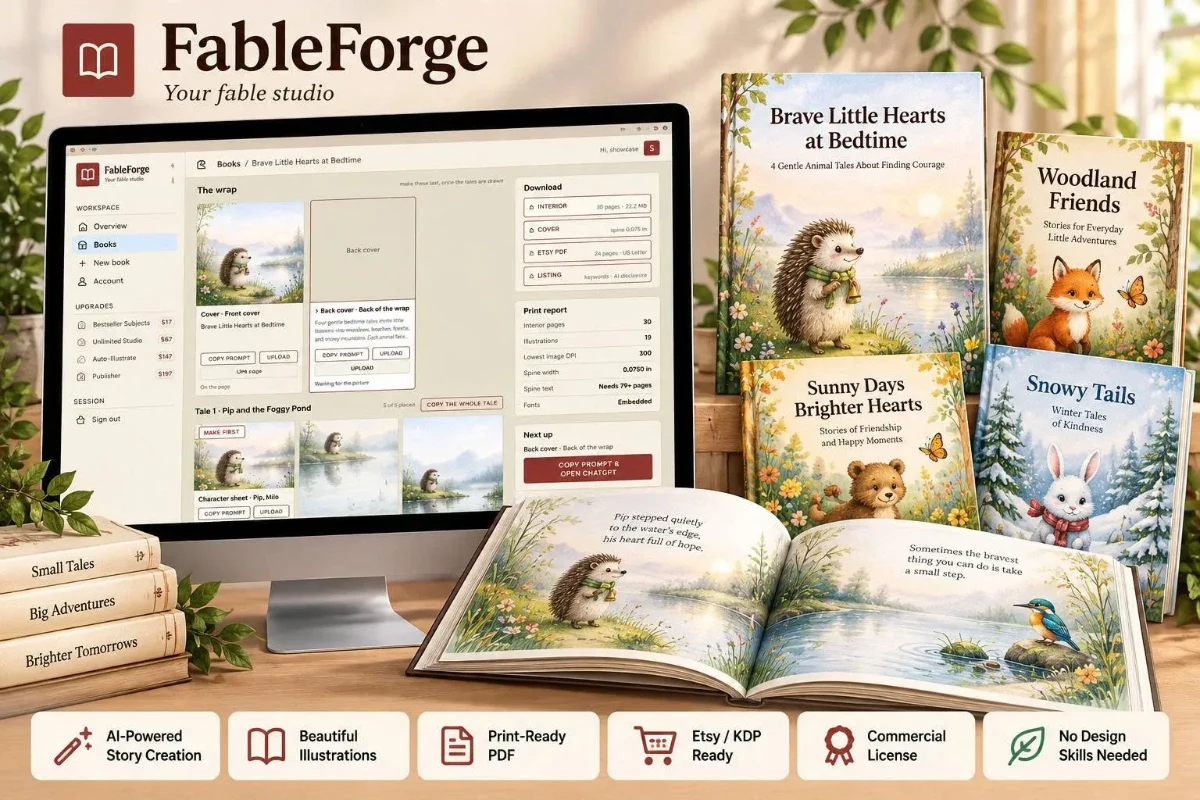
Introduction: Why Story Book Tools Are Booming
Story books are having a moment. Parents want personalized bedtime stories, teachers want fresh reading material, and online sellers have noticed that illustrated books, especially children's books, keep selling year after year. The problem has always been the same: writing a story takes time, and illustrating it takes either real talent or real money.
That's the gap tools like FableForge are trying to fill. In this FableForge review, I'm going to walk you through what the tool is, who it's built for, how the different versions and upgrades are priced, and where I think it makes sense (and where it doesn't). I'll also be upfront about something most review pages skip: the difference between what a sales page promises and what a realistic beginner should expect.
If you only have thirty seconds, here's the short version. FableForge looks like an AI-powered story book creation suite sold in several pieces, starting from a very low entry price of $17. The cheap front end makes it easy to try. The bigger upgrades add up quickly, so you'll want to decide what you actually need before you click anything.
Let's get into the details.
What Is FableForge?
FableForge is an AI-driven product aimed at people who want to create story books without writing every line or drawing every page by hand. Going by the product names in its funnel, the system covers three main jobs: writing the story, illustrating it, and getting it ready to publish. You'll see names like Auto-Write, Auto-Illustrate and Publisher, and they tell you a lot about the intended workflow.
The idea is simple. Instead of juggling a writing tool, an image generator and a formatting program, you work inside one connected system. You pick a subject, let the software draft the story, generate pictures to match, and then prepare the finished book. For someone who has never made a book before, that kind of all-in-one approach removes a lot of friction.
One thing worth saying clearly: FableForge is not a magic button that produces a bestseller. It's a tool. A good tool speeds you up and lowers the barrier to entry, but the quality of what comes out still depends on the ideas you feed it and the time you spend polishing the result. I'll come back to this later because it matters more than any feature list.
Who Is FableForge Best For?
Not every tool suits every person, so let's be specific about who might get real value here.
Beginners who want to try book creation
If you've always wanted to make a children's book but felt stuck at the blank page, a guided tool can get you moving. The low front-end price means you can test the idea without a big commitment.
Affiliate marketers and content creators
Plenty of online marketers look for products that let them create digital assets quickly. Illustrated story books, activity-style content and short fiction can all be used as lead magnets, small digital products, or part of a wider content plan.
Parents, teachers and hobbyists
Not everyone is trying to make money. A parent might want a personalized story for a child. A teacher might want a themed reading page for a class. For these uses, the cheapest version may be all you ever need.
Self-publishers exploring low-content and story books
If you already sell or plan to sell books on online marketplaces, a faster workflow for drafts and illustrations can save hours. Just keep in mind that platforms have their own rules about AI-generated content, and you're responsible for following them.
Who should probably skip it
If you expect to earn a full-time income in a few days without doing any work, this isn't for you, and honestly, no tool is. The same goes for professional authors who need a very distinctive voice or hand-drawn art style. AI-assisted output can be a starting point, but it rarely replaces a skilled creator's finished work.
==> Get The Full AIBizEngine Buying <==
How FableForge Works
I'll describe the workflow in general terms, based on how the product is structured and named. The exact screens and options may differ, so always check the official demo on the sales page for the current interface.
• Choose a subject or idea. This is where something like the Bestseller Subjects add-on comes in. Instead of guessing what to write about, you start from a list of topics that are meant to be popular.
• Generate the story. The Auto-Write component is designed to draft the text for you, so you're editing a draft instead of staring at an empty page.
• Create the illustrations. Auto-Illustrate is meant to produce pictures that match the story, which is normally the most expensive and time-consuming part of making a picture book.
• Prepare the book for publishing. The Publisher component appears to handle the final packaging so the finished book is ready to share or upload.
• Review, edit and polish. This step is on you, and it's the one that separates a forgettable book from a good one.
If that sounds like a lot of steps, remember that each one used to mean a different tool, a different subscription, or a different freelancer. Putting them under one roof is the main selling point.
Key Features of FableForge
Here's what stands out based on the product lineup.
1. AI story writing
The Auto-Write module is the engine of the whole thing. A first draft is often the hardest part for beginners, and having something on the page to react to is a huge advantage. You can rewrite, trim or expand as you like. My advice: never publish the first draft exactly as generated. Read it aloud, fix the awkward lines, and add a detail or two of your own.
2. Automatic illustration
Illustration is where most people give up on picture books. Hiring an illustrator can cost hundreds of dollars for a single book. Auto-Illustrate promises to generate artwork for you, and at $147 it's one of the bigger upgrades, so I'd want to see the demo carefully before buying it. Look for consistent characters from page to page, because that's a common weak point in AI images.
3. Publishing support
The Publisher tier is positioned as the part that takes you from a finished story to a finished book. It's offered both as a one-time purchase and as a monthly option, which gives you some flexibility depending on how often you plan to make books.
4. Bestseller subject ideas
Picking a topic is half the battle in any content business. A list of subjects that tend to attract readers can save you from days of second-guessing. It's a small add-on at $17, and it's the kind of thing that's useful for beginners but optional for anyone who already has ideas.
5. Unlimited Studio
The Unlimited Studio upgrade is aimed at people who want to create without worrying about limits. If you plan to make several books or experiment a lot, the idea of unlimited use is attractive. There's also a special-price version listed at $37, which is noticeably cheaper than the standard $67.
6. Beginner-friendly approach
The whole product seems designed for non-technical users. No design degree, no writing background, no need to learn complicated software. That's a genuine plus, though you should still expect a short learning curve while you figure out how to get the best results.
FableForge Pricing and Upgrades: Full Funnel Breakdown
This is the section most people care about, and it's where you need to pay attention. FableForge isn't a single price. It's a funnel, which means there's a front-end product and several upgrades. Here's the lineup, exactly as listed:
|
Product Name |
Price |
|
FableForge |
$17.00 |
|
FableForge Bestseller Subjects |
$17.00 |
|
FableForge Auto-Illustrate |
$147.00 |
|
FableForge Auto-Write |
$47.00 |
|
FableForge Publisher |
$197.00 |
|
FableForge Publisher Monthly |
$27.00 (monthly) |
|
FableForge Unlimited Studio |
$67.00 |
|
FableForge Unlimited Studio (Special Price) |
$37.00 |
A few things to notice.
First, the entry point is very cheap. At $17 you can get started and see whether the product suits you. That's the number that gets people through the door.
Second, the Bestseller Subjects item is shown as a sub-item under the main product, which usually signals an add-on or a bonus-style offer rather than a separate major upgrade.
Third, the heavy hitters are Auto-Illustrate at $147 and Publisher at $197. Together with the others, the full stack can reach several hundred dollars. I'm not saying that's unreasonable. I'm saying you should know it before you start, not after the third checkout page.
Fourth, Publisher also comes in a monthly version at $27. Monthly pricing lowers the upfront cost but means you keep paying for as long as you use it. Do the math on how many months you'd realistically stay subscribed.
What would it cost to buy everything?
Adding up the one-time prices (front end, Bestseller Subjects, Auto-Illustrate, Auto-Write, Publisher and Unlimited Studio at the regular price), you're looking at roughly $492. If you get the Unlimited Studio at the special price of $37 instead, that comes down to about $462. Those are approximate figures from the listed prices and they don't include any taxes or processing fees, so check the final amount at checkout.
What would a sensible starter setup look like?
If I were testing this myself with a limited budget, I'd start with the $17 front end and spend a few days using it properly. Then I'd only add an upgrade when I hit a real limit, such as wanting AI-generated text (Auto-Write) or needing illustrations (Auto-Illustrate). Buying everything on day one, before you know your workflow, is the most common way people overspend on digital products.
A note on refunds
Most products sold on marketplaces like this come with some kind of money-back guarantee, but the terms differ between products and between upgrades. I don't want to quote a number I can't verify, so please read the refund policy on the official page before you buy, and keep your receipts.
==> Read The Truth FableForge Today <==
A Closer Look at Each FableForge Upgrade
Since the pricing is spread across several products, it helps to look at each one separately and ask a simple question: what problem does this solve for me?
FableForge Front End ($17)
This is the front end and the doorway into everything else. At this price it's closer to an impulse purchase than a business investment, and that's the point. You get to see how the system feels, how fast it works and whether the style of output suits you. If you only ever buy one thing, this is the one that lets you judge the rest.
Bestseller Subjects ($17)
This one is about ideas. Many beginners lose days trying to decide what to write about, and a list of subjects that are meant to attract readers shortens that decision. It's useful if you're new to the book market. If you already have a clear niche, you can safely skip it and use the money elsewhere.
Auto-Write ($47)
The writing module is the one I'd think about first if you don't enjoy writing. A draft that appears in minutes lets you spend your energy on improving it instead of creating it from nothing. If you already write well and enjoy it, you may not need it, since you can simply write your own story and use the illustration tools for the pictures.
Auto-Illustrate ($147)
This is the largest single cost in the lineup, and also the one that probably saves the most money compared with the traditional route, because custom illustrations are expensive. The key question is quality. Watch the demo and look closely at hands, faces and whether a character stays recognizable from one page to the next. If the examples look good to you, the price is easier to justify. If they look rough, no price is cheap enough.
Publisher ($197 or $27 monthly)
Publisher is the premium piece of the funnel. The one-time price is high, so the monthly option is worth a serious look if you're not sure how long you'll use it. As a rule of thumb, if you'd use it for fewer than seven months, the monthly plan costs less; beyond that, the one-time price wins. Your own pace of book creation should decide this, not a countdown timer on a sales page.
Unlimited Studio ($67, or $37 special price)
This upgrade suits people who plan to create a lot and don't want to think about limits. The special price is the better deal by a clear margin, so if you're going to buy it at all, check whether the lower price is available to you at checkout before paying the higher one.
Which FableForge Package Makes Sense for You?
Instead of telling you to buy everything, here's a simple way to think about it based on your goal.
• The curious beginner. Start with the $17 front end only. Use it for a week or two. You'll know quickly whether you want more.
• The parent or teacher. The front end plus Auto-Write is probably enough for personal stories and classroom material. You don't need the premium publishing options for a book that stays at home or in the classroom.
• The side-hustle creator. Front end, Auto-Write and Auto-Illustrate give you the core loop of story plus pictures. Add Publisher once you've made a couple of books and know you want to keep going.
• The serious self-publisher. A fuller stack may make sense, but only after you've tested a small batch. Plan your spending around the number of books you realistically expect to produce in the next few months.
Notice what's missing from every one of these: buying everything on the first day. You never lose anything by waiting a week, and you often learn a lot.
Getting Started With FableForge: A Simple First-Week Plan
If you decide to try FableForge, here's an easy plan that keeps you from wasting time or money.
• Day one. Buy the front end, watch the training or demo material, and look around the dashboard. Don't try to make a perfect book yet. Just get comfortable.
• Day two. Pick one simple idea and create a short story. Keep it small, maybe a handful of pages, so you can finish it.
• Day three. Edit your story by hand. Fix awkward sentences, shorten anything that drags, and add one personal detail.
• Day four. Work on the visuals. Check character consistency and redo anything that looks off.
• Day five. Review the whole book start to finish, as if you were the reader. Ask a friend or family member to read it too.
• Days six and seven. Decide what you actually need next. Maybe it's an upgrade, maybe it isn't. Let the real experience decide.
That small test costs you very little and gives you far better information than any sales page or review, including this one.
Pros of FableForge
• Very low entry price. At $17, trying it out is a small risk.
• Covers the whole book creation process. Writing, illustrating and publishing sit in one connected system instead of three separate tools.
• Beginner friendly. You don't need design or writing experience to get started.
• Flexible purchasing. You can pick only what you need, and there's a monthly option for the Publisher component.
• Time saving. A first draft and a set of illustrations in a fraction of the usual time is a real advantage if you make content regularly.
• Useful for several audiences. Parents, teachers, marketers and self-publishers can all find a use for it.
Cons of FableForge
• The upgrades add up. The total cost can climb far above the headline $17, so you need a clear plan before buying.
• AI output needs editing. Generated stories can sound generic and generated images can have flaws. Plan time to fix both.
• Results depend on you. The tool speeds up the process but won't guarantee sales or readers.
• Platform rules matter. If you publish elsewhere, you have to follow each platform's policies on AI-assisted content, and those rules can change.
• A funnel structure can feel pushy. Multiple upsells during checkout can be confusing if you're not paying attention.
Realistic Expectations: What FableForge Can and Can't Do
This is the part I care about most, because it's where people get burned.
A tool like FableForge can make creating a story book dramatically faster. That's real. What it can't do is create demand. A beautiful book that nobody finds earns nothing. If you plan to sell books, you still need to think about your title, your description, your cover, your audience and how readers will discover you.
Also, because AI tools are available to everyone, thousands of people can make similar-looking books. The people who do well tend to be the ones who add something personal: a clear theme, a consistent character, a good message, or a niche nobody else is serving. Treat FableForge as a way to build your first draft quickly, not as a finished business.
I'd also avoid any promise of overnight income. Anyone telling you a push-button product will replace your salary in a week is selling a dream. A more honest way to think about it: if you put in steady effort for a few months, you might build a small catalog of books and learn what works. That's a reasonable goal, and it's much healthier than chasing hype.
Tips to Get the Best Results From FableForge
• Start with a clear idea. Even with automation, a specific concept (for example, a shy dragon who learns to share) produces a better story than a vague one.
• Edit every draft. Read the story out loud. If a sentence sounds robotic, change it.
• Keep your characters consistent. Check that the same character looks the same on every page before you finalize.
• Think about your reader. A story for a three-year-old uses short sentences and simple words. A story for an eight-year-old can handle more plot.
• Test with a small batch first. Make one book, review it carefully, and learn from it before making ten.
• Check platform guidelines. If you plan to publish and sell, read the current policy on AI-generated content for each platform.
• Add your own touch. A personal dedication, a custom lesson, or a local detail makes your book feel less like everyone else's.
==> Click Here to Get FableForge + Bonus at a Discount Price <==
Common FableForge Mistakes to Avoid
After watching how people use products like this, a few mistakes show up again and again.
Publishing the first draft untouched
AI output can be decent, but it often has a certain sameness. Readers, and platforms, can tell when content is thrown together without care. Spend the extra hour editing. It's the cheapest quality improvement you'll ever make.
Buying every upgrade on impulse
Funnels are designed to make the next purchase feel natural. Pause at each page and ask whether you actually need that piece right now. If the answer is maybe, it can wait.
Ignoring the audience
A book is only valuable if someone wants to read it. Before you make anything, think about who it's for and why they'd pick it up. A clear audience beats a clever tool every time.
Skipping the rules
If you plan to sell your books, read the current policies of the marketplace you're using, particularly around AI-generated text and images. Policies change, and ignoring them can get a listing removed.
Expecting instant results
Building anything that earns money takes time. Treat your first few books as practice. The second book is almost always better than the first, and the fifth is better than the second.
Creative Ways to Use Your FableForge Stories
Story books don't have to end on a bookshelf. Here are some ideas that make the most of a tool like this.
• Personalized gifts. A story built around a child's name or interests makes a memorable birthday or holiday present.
• Classroom resources. Teachers can create short themed stories to support a lesson on kindness, science or seasons.
• Lead magnets. If you run a blog or email list, a short illustrated story can be a friendly freebie that attracts subscribers.
• Bedtime series. Create a recurring character and release a new adventure each week for your family or your audience.
• Small digital products. Short illustrated stories can be packaged and sold, provided you follow the rules of wherever you sell them.
• Content for social media. Individual pages or illustrations can be shared as posts that point back to your main project.
The more ways you can use one story, the more value you get from the time you invested in making it.
FableForge vs Other Options
How does FableForge compare to doing it another way? Here's how I see the main alternatives.
Doing everything manually gives you the most control but takes the most time. You'd write the story, hire or become an illustrator, and format everything yourself. It's the highest quality route and the most expensive in time or money.
Using separate AI tools is the middle path. You can use a general writing assistant and an image generator, then combine the results yourself. It's flexible and often cheap, but you handle all the organization, and keeping characters consistent across pages can be tricky.
Using an all-in-one suite like FableForge trades some flexibility for speed and simplicity. If you value a connected workflow and don't want to learn several tools, this is the appeal. If you enjoy experimenting and customizing, you may prefer building your own setup.
None of these is the single right answer. It depends on your budget, your time and how much you enjoy the creative process.
Is FableForge Worth It? My Final Verdict
So, is FableForge worth it? My honest answer: the $17 entry point is a low-risk way to see whether this style of tool fits you, and for many beginners that alone may be enough. If you find yourself using it regularly and hitting limits, then adding specific upgrades one at a time makes more sense than buying the whole stack at once.
What I like is the clear focus. Writing, illustrating and publishing are the three biggest obstacles to making a story book, and the product is built around exactly those. What I'd be cautious about is the total cost of the full funnel and the temptation to expect results without effort.
If you're a parent, teacher or hobbyist, the basic version may give you everything you need. If you're a marketer or self-publisher, treat it as a productivity tool, plan your upgrades carefully, and focus your energy on choosing good topics and polishing the final product.
Overall, I'd call FableForge a reasonable option for people who want a faster way into story book creation, as long as you go in with realistic expectations and a budget in mind. Visit the official page, watch the demo, check the current refund terms, and decide based on your own goals.
FableForge FAQs
What is FableForge?
FableForge is an AI-powered system for creating story books. It covers writing the story, creating illustrations and preparing the book for publishing.
How much does FableForge cost?
The front end starts at $17. Upgrades range from $17 up to $197, and there is a $27 monthly option for Publisher.
Do I need writing or design skills?
No. It is built for beginners, though editing the AI output will give you a better final book.
Can I make money with FableForge?
It can speed up book creation, but income is never guaranteed. Results depend on your topic, quality and marketing.
Do I need to buy all the upgrades?
No. You can start with the $17 version and add upgrades only if you need them.