Telegram Engine Review Can This $14 Tool Actually Run Your Telegram Channel on Autopilot?
What Is Telegram Engine?
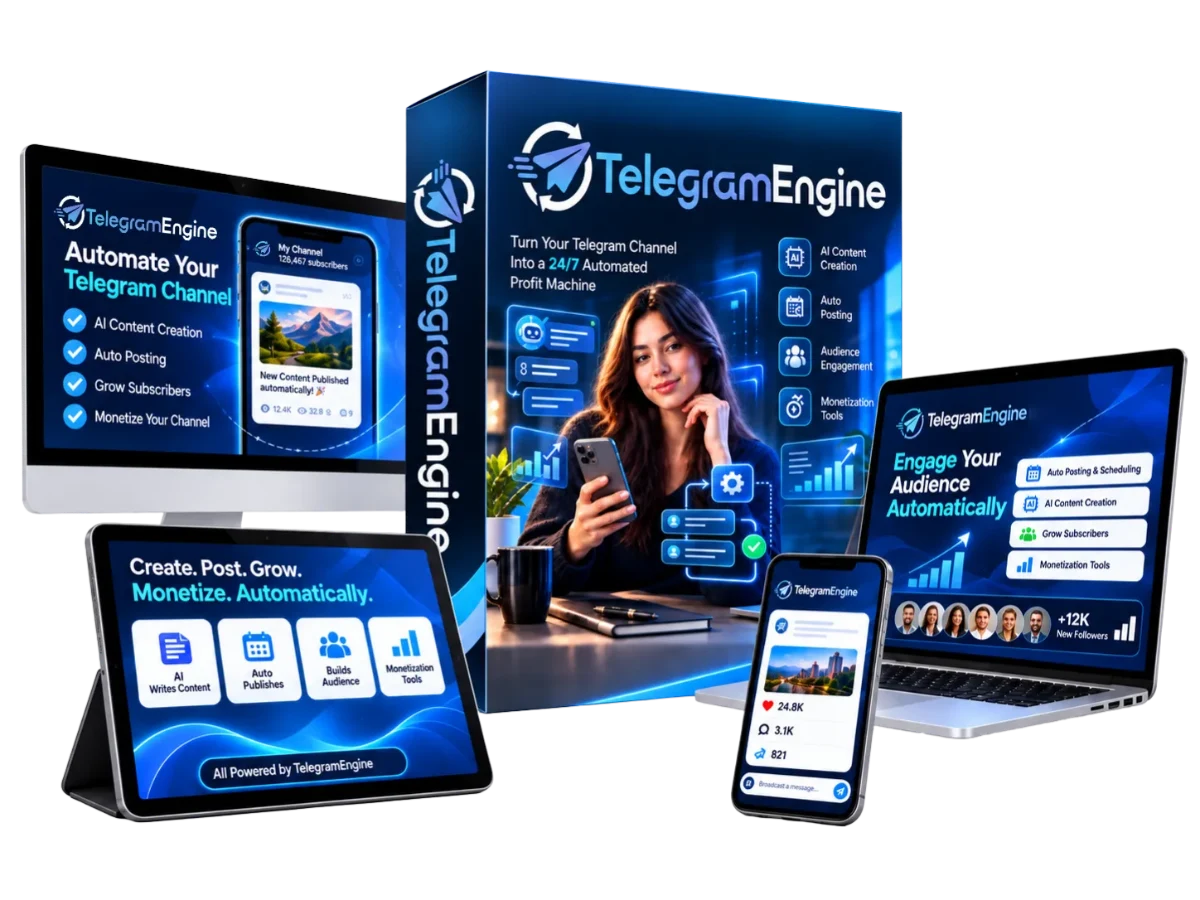
Telegram Engine is a cloud-based dashboard that uses AI to automate the day-to-day operations of a Telegram channel content creation, posting, subscriber engagement, and monetization from a single interface. The core idea is that you choose a niche, configure your channel, set what you want to sell, and let the AI handle the operational work that would otherwise consume several hours a week.
The platform handles four things simultaneously that would normally require separate tools or significant manual effort:
• Content creation and publishing: AI generates niche-relevant posts and either sends them to you for review or publishes them automatically on a schedule you set. You're not writing every post from scratch the AI is doing that, with you deciding how much oversight you want to maintain.
• Product promotion: The AI can promote your own products, AI-generated digital products you create through the platform, or relevant Amazon affiliate offers to your subscriber base. This is the monetization layer built directly into the content workflow rather than bolted on separately.
• Subscriber engagement: Questions from subscribers get answered around the clock by AI, without requiring you to be available at all hours. For anyone who's ever tried to run a Telegram community with any meaningful subscriber count, the volume of questions and engagement that shows up at all hours of the day is one of the fastest ways to burn out.
• Multi-channel management: You can run multiple Telegram channels from the same dashboard different niches, different audiences, different monetization strategies without switching between separate tools or accounts for each one.
The optional element throughout all of this is your own level of involvement. The platform is designed to work on a spectrum from full oversight (review every post before it goes live) to highly automated (set the schedule and let it run). Most operators will probably land somewhere in between reviewing promotions and checking in on engagement while letting the routine content posting run automatically.
Why Telegram Specifically?
Before getting into the feature and pricing breakdown, it's worth spending a moment on why Telegram is the platform this tool is built around because the platform-specific context is what makes the tool's value proposition make sense.
Telegram channels are broadcast-only by design, meaning every subscriber sees every post you publish. There's no algorithm deciding that 3% of your audience gets to see your content today. No pay-to-play boosting. No shadow banning. When you publish something to a Telegram channel, 100% of your subscribers receive it and that's a fundamentally different distribution dynamic than any social media platform built around an algorithmic feed.
The subscriber relationship on Telegram is also different. People who join a Telegram channel have opted in specifically to receive content from that channel they're not accidentally seeing it in a feed. That intent-to-subscribe creates a higher-quality audience relationship than passive social media followers, which is why Telegram channels often see engagement rates that look impressive compared to equivalent-sized social media audiences.
The monetization flexibility is also notable. Telegram channels can promote affiliate offers, digital products, physical products, services, courses, memberships, or anything else without any platform-level restrictions on commercial content, as long as it's legal. You're not navigating Instagram's link-in-bio limitations or YouTube's monetization requirements. Your channel, your offers, your rules.
Put all of that together, and you have a platform with excellent organic reach, high-quality subscriber relationships, and flexible monetization but a real operational cost in terms of content creation and channel management. That's the gap Telegram Engine is designed to fill.
==> Get The Full Telegram Engine Buying <==
Core Features What the Dashboard Actually Does
AI Content Creation and Scheduling
The AI generates niche-relevant posts for your Telegram channel based on the topic and tone you configure. You can set a posting schedule how often, at what times and either have posts sent to you for review before publishing or let the system publish automatically. The review-before-publish option is the sensible starting point for most users, giving you quality control while still removing the work of writing the content from scratch.
The content generation is niche-aware, which matters more than it might initially seem. Generic AI-generated content tends to feel like exactly that generic. A Telegram channel in the personal finance niche needs different content than one in the fitness niche or the home improvement niche, and the quality of your engagement depends heavily on whether the content feels relevant and specific to your audience's interests. How well the AI handles niche specificity in practice is something worth testing during any trial period.
Monetization Integration Products, Affiliate Offers, and Digital Products
This is the layer that turns a content channel into a revenue source. Telegram Engine can weave promotional content into your channel's posting schedule promoting your own digital or physical products, Amazon affiliate offers relevant to your niche, or digital products created through the platform itself.
The Amazon affiliate integration is particularly interesting for anyone building niche channels, because Amazon's product catalog covers virtually every niche with commission-eligible products. A fitness channel can promote equipment and supplements. A home improvement channel can promote tools and materials. A parenting channel can promote children's books and educational toys. The connection between a niche content strategy and a relevant affiliate offer stream is relatively straightforward to build when the affiliate integration is built into the platform.
The AI-generated digital products angle is the newer component of this monetization stack the ability to create and sell digital products that the AI produces, rather than products you've built yourself. This is worth approaching with realistic expectations: AI-generated digital products vary significantly in quality depending on the type of product and how well you configure the generation parameters. But as an additional revenue stream layered on top of affiliate income and your own offers, it adds breadth to the monetization toolkit.
24/7 Subscriber Engagement
Subscriber questions get answered by AI around the clock. This sounds like a smaller feature than it is until you've actually tried to run an active Telegram channel at which point the volume and timing of subscriber questions becomes one of the most demanding parts of channel management. Questions arrive at 2am in your timezone. Questions come in from subscribers in ten different countries. Questions repeat because subscribers don't search the channel history before asking.
AI handling the first-response layer for subscriber engagement doesn't mean you never interact with your audience it means the routine, repetitive questions get handled automatically, and you can focus your actual time on the interactions that benefit from a human response. For channels with more than a few hundred active subscribers, this alone has real operational value.
Multi-Channel Management
The single-dashboard management of multiple channels is the feature that matters most for anyone running more than one niche channel. Without a unified dashboard, multi-channel management means multiple browser tabs, multiple configurations, multiple sets of credentials, and no easy way to see the performance of all your channels at a glance. A single dashboard changes that operational picture significantly, and it's the feature that makes scaling from one channel to several channels something you can actually sustain.
Full Funnel Breakdown Every Tier and Downsell
This is one of the more detailed funnel structures you'll encounter in a launch like this six upgrade tiers, each with its own downsell price. Here's the complete breakdown:
|
Stage |
Product |
Price |
|
FE |
Telegram Engine |
$14 |
|
Bump |
Telegram Engine Special |
$24 |
|
OTO 1 |
Telegram Engine Profit |
$47 |
|
OTO 1 DS |
Telegram Engine Profit Downsell |
$37 |
|
OTO 2 |
Telegram Engine Scale |
$67 |
|
OTO 2 DS |
Telegram Engine Scale Downsell |
$47 |
|
OTO 3 |
Telegram Engine Automation |
$47 |
|
OTO 3 DS |
Telegram Engine Automation Downsell |
$42 |
|
OTO 4 |
Telegram Engine DFY |
$97 |
|
OTO 4 DS |
Telegram Engine DFY Downsell |
$67 |
|
OTO 5 |
Telegram Engine Traffic |
$67 |
|
OTO 5 DS |
Telegram Engine Traffic Downsell |
$47 |
|
OTO 6 |
Telegram Engine Business Box |
$197 |
|
OTO 6 DS |
Telegram Engine Business Box Downsell |
$147 |
FE Telegram Engine ($14) + Order Bump ($24)
The front-end at $14 gives you access to the core Telegram Engine dashboard AI content creation, scheduling, monetization integration, subscriber engagement, and multi-channel management. The order bump (Telegram Engine Special at $24) adds something additional on the checkout page without going through a full upsell sequence.
At $14, the entry point is unusually accessible for a tool with this scope. That price point is specifically designed to maximize the number of people who get into the funnel, with the upgrade tiers handling the revenue that makes the economics work for the vendor. From a buyer perspective, $14 is low enough to test the platform against your actual use case without meaningful financial risk.
OTO 1 Telegram Engine Profit ($47 / Downsell $37)
The first upgrade tier Profit is likely where the monetization capabilities get significantly expanded beyond what's available at the front-end. "Profit" as a name suggests this tier is specifically about unlocking the revenue-generating features at a deeper level: more advanced affiliate integration, better digital product creation tools, or expanded promotional scheduling capabilities. At $47 (or $37 if you take the downsell), this is the first real investment decision after the front-end.
OTO 2 Telegram Engine Scale ($67 / Downsell $47)
Scale suggests expanded capacity more channels, more content volume, more subscribers, or some combination of these. If the front-end limits how many channels you can manage or how many posts per day the AI generates, this tier is almost certainly where those caps come off. For anyone planning to build more than one or two Telegram channels, the Scale tier is the one that makes multi-channel operation fully sustainable.
OTO 3 Telegram Engine Automation ($47 / Downsell $42)
The Automation tier is specifically named around the hands-off functionality that makes the platform's core promise actually work. If the front-end requires more manual oversight or triggers than the fully automated version, this is the tier where true autopilot operation becomes available. The $47 price point (or $42 at downsell) is reasonable for the operational value of genuinely automated content publishing and engagement, if that's what this tier delivers worth confirming with the vendor or sales page exactly which automation features require this upgrade versus what's included at the FE level.
OTO 4 Telegram Engine DFY ($97 / Downsell $67)
DFY Done For You is the premium content and setup tier. At $97 (or $67 at downsell), this is the most expensive core functionality upgrade before the Business Box. Done-for-you typically means pre-built channel setups, pre-written content libraries, or configured monetization campaigns that you can deploy immediately rather than building from scratch. For anyone who wants to launch quickly without going through the configuration and initial content creation process manually, this is the tier that collapses the setup timeline significantly.
OTO 5 Telegram Engine Traffic ($67 / Downsell $47)
A separate traffic tier dedicated to driving subscribers to your Telegram channel rather than just managing the channel once they're there. The subscriber acquisition problem is the other side of the channel management equation: automation tools are only as valuable as the audience you're running them for. The Traffic upgrade addresses that directly, adding traffic strategies or traffic generation tools to the platform alongside the content and engagement features covered by the core product and earlier OTOs.
OTO 6 Telegram Engine Business Box ($197 / Downsell $147)
The top tier in the funnel, and at $197 (or $147 at downsell), it's positioned as a comprehensive business-in-a-box offering. Business Box tiers in funnels like this typically combine reseller or white-label rights, advanced training, done-for-you assets, and the full tool stack everything you need to either run a serious Telegram business or offer Telegram channel management as a service to clients. If you're specifically interested in using Telegram Engine as the foundation of a service business, this is the tier to evaluate most carefully.
==> Read The Truth Telegram Engine Today <==
The Downsell Structure What It Means for Buyers
One thing worth understanding about a funnel with this many downsells is how to use them intelligently. Each upgrade in the Telegram Engine funnel comes with a downsell price that's typically 20-25% lower than the main offer. The downsell is presented if you decline the main OTO price.
This means there's a path through the funnel that costs meaningfully less than buying every upgrade at its main price if you know that declining and taking the downsell is an option. For buyers on a tighter budget who want specific tiers, the downsell prices (Scale at $47, DFY at $67, Business Box at $147) represent real savings over the main OTO prices without losing access to the tier's functionality.
The practical approach: decide which tiers are actually relevant to your use case before going through the funnel, and make your buying decisions based on the functionality you need rather than the sequence of offers you encounter.
Who Should Be Looking at Telegram Engine?
• Affiliate marketers building niche audiences who want a platform with direct reach to every subscriber, without algorithm-dependent traffic. Telegram's 100% delivery rate to subscribers makes it particularly valuable for promotional content that depends on reach.
• Content creators and coaches who already have an audience on other platforms and want to add Telegram as a direct channel particularly for higher-value, more personal content and offers that benefit from the subscriber relationship Telegram creates.
• Local business operators and service providers who want a direct communication channel with customers and prospects, outside of email deliverability issues and social media reach limitations.
• Marketers interested in building multiple niche channels as passive income streams the multi-channel dashboard and AI automation together make running several small niche channels simultaneously more manageable than it would be with manual operations.
• Agency owners and freelancers who want to offer Telegram channel management as a service the Business Box tier (OTO6) specifically addresses this use case with the tools and rights for a service-oriented deployment of the platform.
Honest Assessment Where the Value Is and What to Watch For
Let me give you the straightforward version here, because there are some things about this platform that are genuinely strong and some things worth being clear-eyed about before you commit beyond the front-end.
What's genuinely strong: the core use case automating the operational work of running a Telegram channel addresses a real and significant pain point. The platform-specific nature of the tool (built specifically for Telegram rather than being a generic social media scheduler that added Telegram as an afterthought) matters because Telegram's structure is different enough from other platforms that generic tools don't handle it well. The multi-channel management and the 24/7 engagement automation are the two features with the clearest operational value.
What to be clear-eyed about: at $14 for the front-end, some functionality that's central to the full promise of the platform is almost certainly locked behind the upgrade tiers particularly the Scale and Automation OTOs. The full scope of what's actually included at the front-end versus what requires OTO1, OTO2, or OTO3 is worth confirming specifically before deciding how far into the funnel makes sense for your situation. The downsell structure gives you a path to the tiers you want at lower prices, but you need to know which tiers you actually need first.
The traffic question is also worth addressing directly. Telegram Engine automates the management of an existing channel. Driving new subscribers to that channel is the other half of the equation, and it's addressed specifically in OTO5 (Traffic) rather than being a core feature of the base product. Building a Telegram channel that earns meaningful income requires both good channel management and consistent subscriber growth if you're starting from zero subscribers, the Traffic upgrade becomes relevant early rather than something to consider later.
Overall: at $14 with the ability to test the core functionality, the front-end is a low-risk starting point. The OTOs worth prioritizing for most users are Scale (for multi-channel and expanded capacity), Automation (for genuine hands-off operation), and Traffic (for subscriber growth) though the right combination depends on where you are in building your Telegram presence and what your specific goals are.
Frequently Asked Questions (FAQs)
Q1. Do I need an existing Telegram channel to use this?
You'll need to create a Telegram channel if you don't have one, but the platform is designed to be the starting point for building one, not just a management tool for established channels. The setup process should walk you through connecting a new or existing channel to the dashboard.
Q2. How automated is the front-end do I still need to review every post?
The front-end includes a review-before-publish option and an automatic posting mode. How much automation is available at the $14 front-end versus what requires the Automation OTO ($47) is worth confirming with the sales page, as full autopilot operation may be an OTO3 feature.
Q3. Can I use this for multiple niches and channels?
Multi-channel management is part of the platform's core design. Caps on how many channels you can run from the dashboard at the front-end tier (versus with the Scale OTO) are worth checking before assuming unlimited multi-channel access at the entry price.
Q4. Does this work if I have zero Telegram subscribers right now?
Yes, but subscriber acquisition is addressed specifically in OTO5 (Traffic). The core platform manages and monetizes your channel content and engagement growing the subscriber base benefits from the Traffic upgrade if you're starting from scratch.
Q5. Is the downsell price the same product as the main OTO?
Typically yes, though sometimes with slightly reduced limits or features. If you decline a main OTO price, you'll be offered the downsell for the same tier at a lower price taking the downsell is usually the smarter move if you want that tier's functionality but the main price felt high.
Telegram's direct reach, zero algorithm suppression, and high subscriber intent make it one of the most underused platforms in affiliate marketing. Telegram Engine is built to close that gap.
At $14 to start, with the ability to test the AI content and channel automation before committing to any of the upgrades, the front-end is a practical entry point for anyone serious about building a Telegram presence. The upgrade path is deep but logically structured each tier adds something distinct, and the downsell prices give you a route to the functionality you need without paying the full OTO price at every step.