Talking Deck Review Can One Keyword Really Become a Narrated Kids’ Story Video?
Introduction
Children’s stories have a strange problem right now. Writing one is easier than it has ever been, but getting it in front of kids is harder. Children don’t only flip through picture books anymore. They watch read-aloud videos, they scroll through Shorts, and plenty of parents press play on a bedtime story while the toothbrush is still in someone’s mouth. If you create children’s content, you’ve probably felt the pressure to be a writer, an illustrator, a voice actor and a video editor all at the same time.
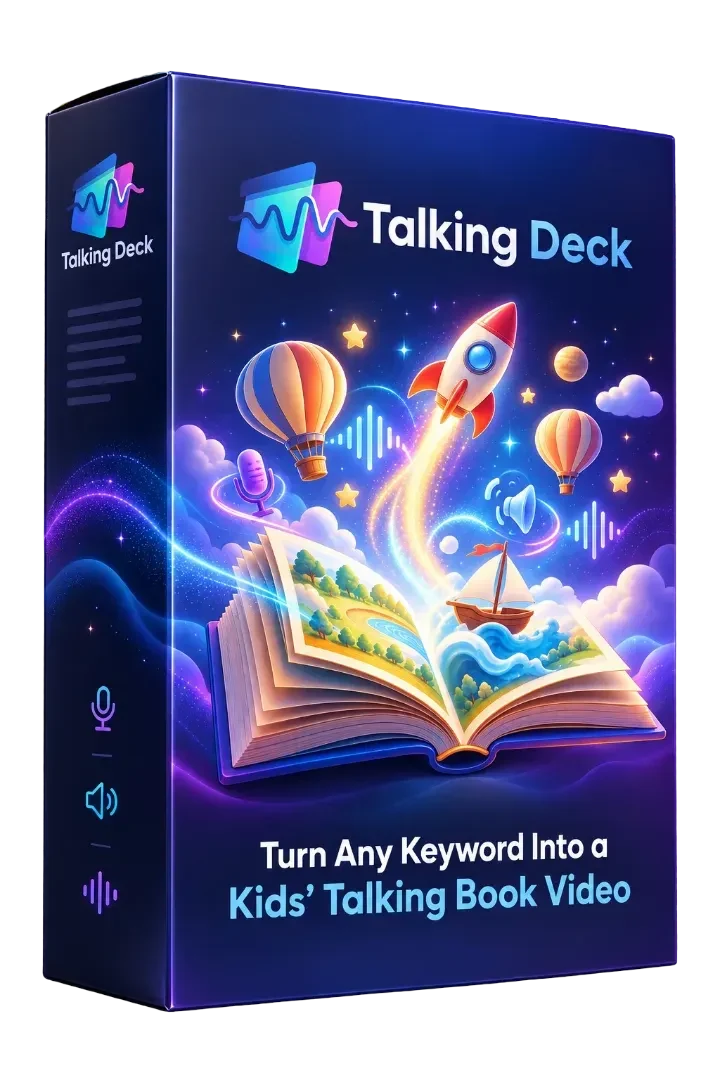
That gap is exactly what Talking Deck is built for. It’s a guided app that takes a single keyword and helps you turn it into a children’s story, page-by-page illustration prompts, an expressive voiceover, a narrated video and a printable PDF storybook, in up to 32 languages. It went live on October 30, 2026 on WarriorPlus, with a one-time front-end price of about $17.
In this Talking Deck review, I’ll walk through what the app does, how the workflow runs, what each price tier gives you, who it suits and where it falls short. A quick note before we start: this review is based on the details the creator has published about the product, so double-check the official sales page for the latest specifics before you buy.
Why Kids’ Story Videos Matter
Before judging any tool, it helps to understand the problem it claims to solve. Read-aloud videos of picture books pull in huge audiences on YouTube, and short vertical clips keep spreading on platforms where parents and kids already spend their time. A story that exists only as a paperback or a PDF is leaving attention on the table.
The catch is the workload. A single narrated picture book normally means illustrations, a voice recording, editing software and several export formats. Many creators with good story ideas never get past that wall. They write the book, then stall because the video side feels like a second full-time job.
Talking Deck is aimed squarely at that wall. It doesn’t promise better storytelling than you can do yourself. It promises to cut the production steps between an idea and a finished, narrated, shareable product. That’s a more modest promise, and it’s also a more believable one.
👉 Visit Official Talking Deck Website and Claim 30% Discount Today
What Is Talking Deck?
Talking Deck is a guided creative app for building children’s story projects from start to finish. You give it a keyword like “rain” or “sharing toys,” and it shapes a story around it, along with the illustration prompts for every page. After that, it takes care of the voiceover, the video rendering and the PDF storybook.
One thing is worth knowing early. Talking Deck doesn’t draw the pictures itself. It works alongside ChatGPT, which writes the story and creates the illustrations from the prompts Talking Deck prepares. The narration and the video rendering then happen inside Talking Deck. So it’s better to think of it as a director that organizes the whole production, not a single magic button that spits out a finished book.
That arrangement keeps the app focused on what it does best: organizing the project, voicing it and rendering it. It also comes with one clear requirement. You’ll want a ChatGPT account ready before you begin, otherwise you’ll stall halfway through the process.
How Talking Deck Works, Step by Step
The workflow is split into two stages. Both are designed so that someone with no design or editing experience can follow along.
Step 1: Story and Visual Creation
You start by typing a keyword. From there, you can pick one of 13 story types and one of 8 character casts, or leave both on Auto and let the app decide. Next you choose a language and one of 18 visual styles. The story is then built scene by scene, with matching visuals for each page, and you can create the PDF storybook whenever you want a book version.
There are two ways to run this stage. Full Auto sets up the details for you, which is handy when you just want to see how a story turns out. Advanced Setup hands you more control, which is better once you know the kind of series you’re trying to build.
Step 2: Voiceover and Video Creation
Once the story is ready, you copy, paste and generate the voiceover. The emotion for each line is already built in, so the narration can whisper, laugh, sound excited or even sing, depending on the page. After that, you pick a wide or vertical format, choose between one full video or one-minute parts, select a camera style for vertical videos and render everything right inside the app.
A few small touches make life easier. You can lay soft background audio under the narration, and every project auto-saves, so you can come back later and create a new language version of the same story without starting over.
In real use, the slowest part will probably be generating and checking the illustrations in ChatGPT. Characters need to look the same from page to page, and sometimes a page needs regenerating to get there. That’s true of any AI-illustrated book, not just this one, but it’s worth planning your time around it.
Who Is Behind Talking Deck?
Talking Deck was created by Maulana Malik, a product creator who builds tools for KDP publishers, printable sellers and content creators under the Duoha brand on WarriorPlus. His background in this niche shows in the product’s structure. Thirteen story types multiplied by eight casts, eighteen named art styles and three camera styles designed so young viewers can follow the words all suggest someone who thinks like both a storyteller and a publisher.
The product is also backed by a 30-day performance guarantee and a dedicated support page. That doesn’t guarantee you’ll love it, but it does mean there’s a safety net if the app doesn’t work the way it’s described.
Talking Deck Key Features
Here are the features that matter most when you’re deciding whether this tool earns a place in your workflow.
13 Story Types and 8 Character Casts
You can pick from story types such as Bedtime Story, Classic Fable, Funny Story, Kids Mystery and Healthy Habits, then pair them with casts like Human Kids, Robots, Dinosaurs or Sea Creatures. You can also write your own. That adds up to 104 combinations from a single keyword, and fresh plot twists mean the same keyword shouldn’t hand you the same book twice.
18 Visual Styles
The style list runs from Watercolor and Pencil to Clay Stop-Motion, Risograph Print, Retro 1950s Storybook and Soft Anime Storybook. This matters more than it sounds. A soft watercolor look suits a bedtime tale, while a bold cartoon style fits an adventure. Matching style to story gives each book its own identity and helps it avoid the generic AI look.
Expressive Voiceovers
Flat, robotic narration is the quickest way to lose a child’s attention. Talking Deck’s voiceovers are designed to whisper, laugh, show excitement, sing or slow down sleepily to follow the mood of each page. Because the emotion is already attached to every line, you don’t have to hand-direct the performance.
In-App Rendering With No Per-Render Fees
Voiceovers and videos are produced inside Talking Deck, so you aren’t charged each time you render. If you plan to publish a series, or make several language versions of one story, this removes a cost that normally grows with every video.
Wide and Vertical Videos Up to 2K
You can render 16:9 videos up to 2K (1440p) for YouTube, websites and classrooms, or 9:16 vertical videos for Reels, TikTok and Shorts. Vertical stories can be one full video or split into parts of about one minute each, which makes them easy to post as a series.
Three Camera Styles
Dynamic Movement shifts between the words, the picture and the full page. Follow the Words highlights the text as it’s read aloud. Full Scene, No Zoom keeps the whole page visible. These options make vertical videos more comfortable to watch and easier for little ones to read along with.
32 Languages
You can prepare stories and voiceovers in English, Spanish, French, German, Arabic, Hindi, Mandarin, Japanese and 24 more languages. One finished story can reach several markets, which multiplies the value of every book you make.
Printable PDF Storybooks
The built-in PDF book combiner turns your pages and cover into a print-ready storybook. That’s useful for printables, digital downloads, classroom resources and publishing projects.
Guided Studio With Auto-Saved Projects
Story, pictures, voice, PDF and video all sit in one step-by-step workspace, complete with a live story preview, saved projects and a built-in video guide for your first book. You also get background audio and the PDF combiner as extras with the app.
👉 See the Current Talking Deck Creator Price and Bonuses
Tips for Getting Better Results From Talking Deck
Any guided tool works better when you feed it good input. These practical habits should help you get more out of Talking Deck, whatever your goal.
Pick Specific Keywords
A keyword like “rain” or “brushing teeth” gives the app something concrete to build on. Vague keywords tend to produce vague stories. If you’re making a series, choose a simple theme that kids genuinely care about, like sleep, sharing, bravery or daily routines.
Keep One Visual Style Per Series
If you’re planning several books, stick with one art style and one tone across all of them. A consistent look makes a series feel professional, and it helps parents recognize your work at a glance. Switching styles from book to book can make a channel or shop feel scattered.
Test Before You Commit
Make one short story first and watch the full video from start to finish. Check the pacing, the voice and the camera style. It’s much cheaper to learn what you like on a single test project than after you’ve produced ten books.
Plan for Illustration Time
Because the pictures come from ChatGPT, budget some time for regenerating pages where a character looks different. Keep your character description consistent in every prompt, and review each page before moving on to the voiceover.
Reuse One Story in Many Ways
A finished story can become a PDF for sale, a wide video for YouTube, several vertical clips for social media and a second-language version for a new audience. Planning those uses from the start is where the app’s one-time price pays off most.
Talking Deck Pricing and Upgrades
The front end costs a one-time payment of around $17 through WarriorPlus, with instant access. It includes the full guided studio: the story types, casts, visual styles, voiceovers, 32 languages, wide and vertical rendering, camera styles, background audio and the PDF combiner. A 30-day performance guarantee covers technical issues that stop the app from working as described.
Like most WarriorPlus launches, there’s also a set of optional upgrades. Here’s the price list as shown at the time of writing:
|
Product |
Price |
|
Talking Deck (front end) |
$17.05 |
|
Talking Deck Pro |
$25.01 |
|
Talking Deck Machine |
$37.00 |
|
Talking Deck Activity |
$47.01 |
|
Talking Deck MAX |
$4.95 |
|
Talking Deck PLATINUM |
$4.95 |
|
Talking Kids Deck Bundle |
$197.00 |
Exactly what each upgrade adds isn’t spelled out in the material I could find, apart from the fact that Pro, Activity and Machine are separate editions of the app and the bundle packages the kids’ range together. Prices can also change during a launch window. So read the description on each upgrade page before you click yes.
My advice is simple. Start with the front end and use it on two or three stories. Once you know where your own workflow gets stuck, you’ll know which upgrade, if any, is worth paying for. Buying the whole stack on day one is rarely the smart move with any software.
Is the front end good value? Probably, for the right person. Hiring a narrator and a video editor can easily cost over $100 for a single video, and many AI video tools charge monthly. Here the voiceovers and renders are included, so each extra video or language version costs nothing more. That makes the math friendly if you plan to produce more than a handful of stories.
Who Should Use Talking Deck?
Talking Deck looks like a natural fit for several kinds of people:
• KDP publishers: turn each children’s book into a narrated video and Shorts that promote the paperback, and publish in several languages.
• Printable sellers: create PDF storybooks for Etsy or your own store, with a matching video that shows buyers what’s inside.
• YouTube and short-video creators: run a read-aloud channel with wide 2K videos and one-minute vertical parts for Reels, TikTok and Shorts.
• Teachers and educators: make narrated stories about feelings, healthy habits or nature, in the languages your students speak.
• PLR creators: build story-based packs with PDFs and videos to include in digital product offers.
• Parents: create personal bedtime stories starring your child’s favorite animals or vehicles.
It’s probably not for everyone, though. If you want a fully hands-off tool that produces finished illustrations without any outside account, this isn’t it, because ChatGPT is part of the process. If you’re hoping for guaranteed income, be careful too. No tool can promise sales. It can only lower the effort of making the product. Finding buyers and viewers is still your job.
Talking Deck vs. Alternatives
To see where Talking Deck fits, it helps to compare it with the usual ways people produce narrated kids’ content. The figures below are rough, typical ranges rather than exact quotes.
|
Option |
Cost |
Narration |
Video + PDF |
Languages |
|
Talking Deck |
About $17 once |
Built in |
Both |
32 |
|
AI video tools |
$20–$60 per month |
Basic |
Video only |
Varies |
|
Hired narrator and editor |
$100+ per video |
Yes |
Extra cost |
One per hire |
|
Manual editing software |
Hours of your time |
Record yourself |
Separate tools |
Your own |
The main advantage is the combination. Most alternatives give you either a video or a book, and you pay again for each language. Talking Deck bundles story, voice, video and PDF into one workflow, with a one-time price rather than a subscription. The trade-off is the dependence on ChatGPT for the pictures, which a fully closed tool would not ask of you.
✅ Yes, Show Me the Talking Deck Creator Deal and Bonuses
Pros and Cons of Talking Deck
What We Like
• One keyword becomes a story, a 2K video, vertical shorts and a printable PDF.
• Expressive narration that whispers, laughs and sings along with the story.
• 18 visual styles and 104 story combinations from a single keyword.
• 32 languages and no per-render fees.
• A low one-time price with a 30-day performance guarantee.
What to Keep in Mind
• It works alongside ChatGPT for the story and pictures, so you need an account ready.
• Characters may need a page or two regenerated to stay consistent, which adds time.
• The upgrade list is long, and the details of each upsell aren’t fully explained up front.
• Results depend on your own marketing. The app makes content; it doesn’t bring buyers.
Common Mistakes to Avoid
Even a simple tool can disappoint when it’s used the wrong way. Here are the mistakes that are easiest to make with a product like this.
• Buying every upgrade at once. The front end is a complete studio. Add upgrades only after you’ve proved to yourself that you need them.
• Skipping the review step. Always watch a full render before publishing. A mispronounced word or a mismatched picture is far easier to fix before upload.
• Expecting instant income. Content creation takes consistency. A tool can speed up production, but audiences and buyers take time to build.
• Ignoring the platforms’ rules. Check the publishing and AI-content policies of Amazon KDP, Etsy and YouTube before you upload, since requirements can change.
• Making one-off books. The format pays off most when you build a series with a repeatable look and a clear audience.
Avoid those five and you’ll already be ahead of most people who buy a tool like this and abandon it after a weekend.
Final Verdict: Is Talking Deck Worth It?
Talking Deck brings children’s stories to life in the formats that matter today: a narrated 2K video, vertical shorts, a printable PDF and multiple languages, all from one guided studio. At roughly $17, with no per-render fees and a 30-day guarantee, it’s an easy tool to try if you publish on KDP, sell printables, teach or run a read-aloud channel.
Go in with realistic expectations. You’ll need ChatGPT, you’ll spend some time polishing illustrations, and you should skip the upgrades until you’ve tested the basics. If you can live with those points, Talking Deck offers a lot of production power for a small price, and it’s worth a look while the launch pricing is still available.
Talking Deck FAQs
Does Talking Deck create the images?
No. It prepares the story and image prompts, and you generate the illustrations in ChatGPT.
Do I need a ChatGPT account?
Yes. ChatGPT writes the story and creates the pictures, while Talking Deck handles the guidance, voice and video.
Do I pay for every render?
No. Voiceovers and videos are produced inside the app with no per-render fees.
Can I make videos for Shorts, Reels and TikTok?
Yes. You can render vertical 9:16 videos as one full story or as one-minute parts.
Is there a money-back guarantee?
There’s a 30-day performance guarantee that covers technical issues stopping the app from working as described.