Skribbly Review Is This $17 Whiteboard Video Maker Actually Worth Buying?
If you've ever tried to make an explainer video, you already know the pain. You need a script, you need visuals, you need a voice, and then you have to stitch it all together without the final result looking like a school project. Hire a freelancer and one short whiteboard video can cost somewhere between $135 and $285. Do it yourself and you might lose a whole weekend learning software you'll never open again.
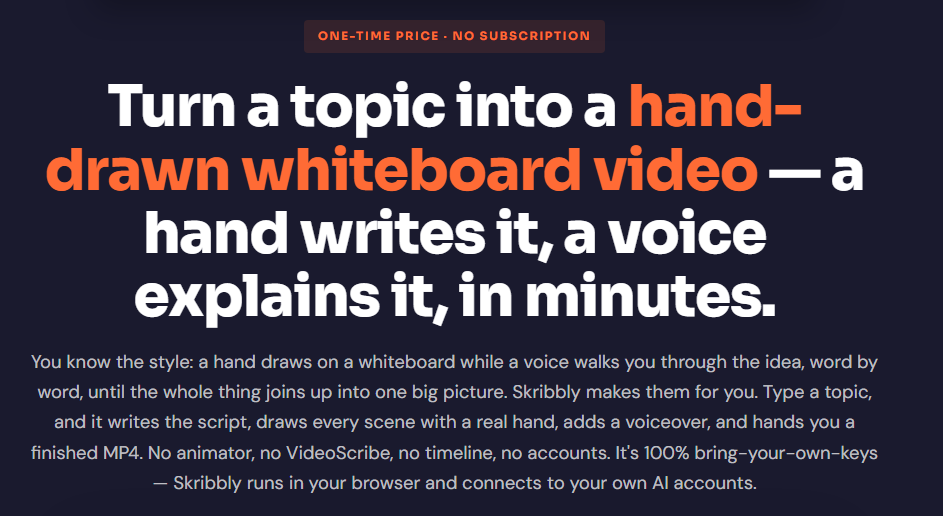
Skribbly claims there's a third way. You type in a topic, and the tool writes a script, draws the scenes in a hand-drawn whiteboard style, adds a voiceover, and hands you an MP4 with captions. The front-end price is $17, paid once, with no monthly plan attached.
That sounds almost too neat, so I went through the sales material, the full funnel, the pricing and the independent write-ups to see what actually holds up. This Skribbly review covers what the tool does, what it really costs once you count the AI credits, which upgrades are worth your money, and who should probably walk away.
Skribbly Review at a Glance
Before we get into the details, here's the short version in one place.
|
Detail |
Information |
|
Product |
|
|
Type |
Browser-based whiteboard explainer video maker |
|
Front-end price |
$17 one-time |
|
Bundle price |
$97 one-time (full app plus all upgrades) |
|
License |
One key, two devices |
|
Output |
1080p MP4 with captions |
|
Setup |
Bring your own API keys (script, images, voice) |
|
Estimated cost per video |
About $1 to $3 in AI credits |
|
Refund |
30-day money-back guarantee |
|
Best for |
YouTubers, affiliate marketers, freelancers, teachers |
What Is Skribbly?
Skribbly is a browser-based whiteboard explainer video maker. The idea is simple. You give it a topic, and it builds a short video that looks like someone is drawing the story by hand on a whiteboard. Think of the classic doodle-style explainers you see all over YouTube, the ones where a marker sketches a lightbulb while a calm voice explains a concept.
Those videos work for a reason. The moving pen holds attention, the simple drawings keep the message clear, and viewers tend to stick around to see what gets drawn next. The problem has always been production. Making one by hand takes research, scripting, illustration, recording and editing. Skribbly tries to squeeze all of that into a single workflow that runs inside your browser.
What makes it a little different from the usual video tools is the pricing model. There's no subscription to Skribbly itself. You pay the one-time fee, and then you connect your own AI accounts and pay those providers directly for whatever you use. We'll look at what that means in practice in a moment, because it's the single most important thing to understand before you buy.
Who Is Skribbly Built For?
The people who benefit most from a tool like this are creators who need a steady stream of simple, clear videos and don't want to hire anyone to make them. That includes a few groups in particular.
• YouTubers who run explainer, educational or faceless channels and want to publish more often.
• Affiliate marketers who want to teach first and sell second, using short videos to introduce a product or a topic.
• Freelancers and small agencies who sell short explainer videos to local businesses.
• Teachers and course creators who need quick visual summaries of a lesson.
• Bloggers who want to turn written posts into video and reach people who don't read much.
If you're after cinematic footage, talking-head clips or flashy motion graphics, this isn't the tool. Skribbly does one style, and it does it on purpose.
==> Get The Full Skribbly Buying <==
How Skribbly Works
The workflow is refreshingly short. You pick a topic, and Skribbly uses an AI model to write the script. Then it generates illustrations for each scene, adds a voiceover, and records the whole thing as a video with captions. When it's done, you download an MP4.
The part that trips people up is the setup. Skribbly runs on a bring-your-own-keys model. In plain English, that means you connect your own accounts with the AI companies that do the heavy lifting. According to the published information, the typical setup looks like this:
• An Anthropic account for writing the script.
• An OpenAI account for generating the illustrations.
• An ElevenLabs or Fish Audio account for the voiceover, with built-in AI voices also available if you'd rather skip that step.
You create those keys once, paste them into Skribbly, and you're done. It takes a few minutes. After that, every video you make draws on those accounts, and you pay the providers directly for what you use. Skribbly itself never charges you again.
A Few Things to Know Before You Start
Two practical details are worth knowing up front. First, Skribbly runs in desktop Chrome, so don't expect to produce videos from your phone. Second, the video is recorded in real time. If a video runs three minutes, the recording takes about three minutes, and the browser tab needs to stay open while it happens. It's not a dealbreaker, but if you're hoping to click a button and get an instant file, you should adjust your expectations. Most people simply do something else on a second screen while it records.
I'd also suggest setting a spending limit with each AI provider from day one. It's a small habit that takes a minute and protects you from surprises if you ever make a mistake with a setting.
Key Features of Skribbly
Let's go through what you actually get for your money.
AI-Written Scripts
You don't need to start with a finished script. Type in a topic and the tool drafts one for you. This is the feature that saves the most time for people who dread the blank page. You can still edit the script before the video is made, which matters, because AI text needs a human pass if you want it to sound like you.
A Genuine Hand-Drawn Look
This is the headline feature. Instead of sliding stock images across the screen, Skribbly produces scenes that look drawn on a whiteboard. Many cheaper AI video tools produce what is basically a slideshow with a voiceover on top. Skribbly's look is more distinctive, and in a crowded feed that can help your videos stand out.
AI Voiceovers
You can use natural-sounding AI voices, either through your own ElevenLabs or Fish Audio account or through the built-in options. Voice quality is a big part of whether an explainer feels professional, so having choices is useful.
Captions Built In
The finished video comes with captions. That's more important than it sounds. A large share of people watch short videos with the sound off, so burned-in captions help your message land even when no one is listening.
1080p MP4 Export
You get a standard 1080p MP4 file you can upload anywhere: YouTube, your website, a course platform, a client's inbox. There's no weird file format to deal with.
Horizontal and Vertical Formats
Skribbly supports 16:9 for YouTube and similar platforms, and 9:16 for Reels, Shorts and TikTok. In the bundle, both formats are unlocked from day one. If you buy the front end alone, you may need an upgrade to get vertical output, which we'll cover below.
One License, Two Devices
A single license key works on two devices. For a solo creator that's plenty. A desktop and a laptop is the usual combination.
What Does It Really Cost to Make a Video?
This is where a lot of reviews get lazy, so let's slow down and do the maths properly.
The $17 you pay for Skribbly is a one-time fee. But because the tool uses your own AI accounts, every video also costs a small amount in credits. Based on the vendor's own figures, the numbers break down like this:
• The script costs less than ten cents.
• Illustrations run about $1.25 for a six-scene video and about $2.75 for a twelve-scene video.
• Voiceover costs depend on which provider you choose and how long the video is.
Put together, the vendor puts the cost at roughly $1 to $3 in credits per video. That's a fair estimate for short videos, though your own number could climb if you use premium voices or make longer projects.
How That Compares to Other Options
Let's compare it with the alternatives most people consider.
• Hiring a freelancer: The sales page quotes $135 to $285 for one short whiteboard video. Treat that as the vendor's claim, but it lines up with what many freelancers charge for custom animation.
• Monthly AI video subscriptions: These often cost a monthly fee whether you use them or not. They're quick, but most produce slideshow-style videos without a real hand-drawn feel.
• Traditional whiteboard software: Tools like VideoScribe give you a lot of control, but you build everything yourself. That takes time, and there's a learning curve.
If you publish four videos a month, Skribbly's total cost for the first month is the $17 purchase plus perhaps $4 to $12 in credits. A freelancer would cost you somewhere between $540 and $1,140 for the same output. Even if you stretch the AI costs well past the estimate, the gap is huge.
The honest caveat is that cheap doesn't automatically mean good. You're trading custom control for speed and price, and that trade suits some projects better than others.
==> Read The Truth Skribbly Today <==
The Complete Skribbly Product Lineup and Prices
One thing I want to be upfront about: Skribbly isn't a single product. It's the front-end app plus a group of upgrades and related tools, and the prices add up quickly if you buy them one by one. Here's the full list.
|
Product Name |
Price |
What It Appears to Cover |
|
Skribbly Bundle |
$97.00 |
Full app plus all upgrades, one license |
|
Skribbly Video Maker |
$17.00 |
Core topic-to-whiteboard-video app |
|
Skribbly Publish Kit |
$9.95 |
Help with publishing finished videos |
|
Captionly |
$47.00 |
Word-synced caption video tool |
|
Skribbly Listicles |
$24.95 |
List-style video format |
|
Skribbly Reels |
$17.00 |
Short vertical video format |
|
Skribbly Retention Scripter |
$17.00 |
Scripting aimed at keeping viewers watching |
|
Skribbly Theme & Font Pack |
$12.95 |
Extra styles and fonts |
|
Skribbly X vs Y |
$24.95 |
Comparison-style videos |
A quick note on how to read this. The descriptions in the third column are based on the product names and the general information available, so treat them as a guide rather than a final spec. Sales pages change, and the vendor may adjust prices or features at any time, so always confirm the details on the official page before you pay.
What the Main Items Appear to Offer
Skribbly Video Maker ($17). This is the core app and the thing most people should start with. It handles the topic-to-video workflow described above.
Skribbly Bundle ($97). This packages the full app together with every upgrade in one payment. You get a single license key and everything is unlocked from the start, so there are no upgrade pages to click through after checkout.
Skribbly Publish Kit ($9.95). The name suggests help with getting finished videos out into the world, such as titles, descriptions and other publishing details. It's the cheapest item on the list.
Captionly ($47). This is a separate tool focused on word-synced caption videos. If you like text-driven videos where words animate along with the voice, this is its own product rather than an add-on for the whiteboard style.
Skribbly Listicles ($24.95). Judging by the name, this is for list-style videos, the kind with "five reasons" or "seven mistakes" formats that perform well on social platforms.
Skribbly Reels ($17). This appears to be aimed at vertical, short-form content for Reels, Shorts and TikTok.
Skribbly Retention Scripter ($17). The name points to scripting help that keeps viewers watching for longer. Anything that improves watch time is worth considering if you're serious about YouTube.
Skribbly Theme & Font Pack ($12.95). Extra visual styles and fonts. This is the upgrade for people who worry that all their videos will look alike.
Skribbly X vs Y ($24.95). A comparison-style format, which is popular for product roundups and "this versus that" content.
Is the Bundle Worth $97?
If you add up the individual prices, the bundle clearly costs less than buying every piece separately. But that's not really the right question. The real question is whether you'll use most of what's inside.
Here's how I'd think about it.
• If you're testing the waters, buy the $17 front end. See whether the style suits your content before spending more.
• If you already know you'll make vertical videos, list-style videos and comparisons regularly, the bundle makes sense. It saves you money and spares you from stacking separate purchases.
• If you only care about one format, pick the single upgrade that matches and ignore the rest.
The one genuine advantage of starting with the front end is that you can decide what you need after you've used it. The one genuine advantage of the bundle is that you get everything on day one with a single license.
==> See My 30-Day Skribbly Here <==
Pros and Cons of Skribbly
No tool is perfect, so here is a balanced view of what works and what doesn't.
What We Like
• The one-time price is low, and there's no subscription to Skribbly itself.
• The hand-drawn whiteboard style is distinctive and doesn't look like a generic slideshow.
• The full workflow from topic to finished MP4 happens in one place.
• Per-video costs are low, roughly $1 to $3 in credits according to the vendor.
• You choose your own AI providers, so you stay in control of quality and spending.
• A 30-day money-back guarantee lowers the risk of trying it.
• Captions are built into the finished video.
What Could Be Better
• The bring-your-own-keys setup takes a few minutes and isn't ideal for complete beginners.
• Recording runs in real time, so there's no instant export.
• It works in desktop Chrome, so you can't use it comfortably on a phone.
• There's essentially one visual style. That's fine if you love whiteboard videos and limiting if you don't.
• The upgrades can add up if you buy them separately.
• AI credit costs are small but real, and they're not under Skribbly's control.
Skribbly vs. the Alternatives
It helps to see where Skribbly fits against the other ways of making explainers.
Skribbly vs. a freelancer. A good freelancer will give you more creative control, original illustrations and a human touch. They'll also cost you far more and take days rather than an hour. For a one-off brand video, hire a pro. For regular content, Skribbly's economics are hard to beat.
Skribbly vs. AI slideshow video tools. Many of these tools turn text into video in minutes, and they're often sold monthly. They're fast, but the finished product usually looks like moving stock images. Skribbly takes longer to render but delivers a more recognisable hand-drawn identity.
Skribbly vs. VideoScribe-style software. Traditional whiteboard software gives you manual control of every element. That's great if you enjoy the craft and have the time. If you want to publish regularly with minimal effort, an automated tool is the more practical choice.
None of these is the "best" in an absolute sense. It depends on whether your priority is control, speed, cost or style.
A Practical Workflow for Getting the Most Out of Skribbly
If you decide to buy, a few habits will help you get better results from day one.
Start with a narrow topic. "How compound interest works" will give you a stronger video than "personal finance." Specific topics lead to clearer scripts and more focused scenes.
Edit the script before you render. The AI draft is a starting point. Read it out loud, cut anything that sounds stiff, and add a personal example or two. That small step is what makes a video feel like yours.
Keep videos short at first. Six scenes are cheaper and faster than twelve, and short videos are easier to review. Once you're happy with the process, you can scale up.
Test your voices. Spend a few minutes comparing options. A voice that suits a calm educational video may feel wrong for a punchy list video.
Set spending limits. I mentioned this earlier, but it's worth repeating. A cap on each AI account means you never have to worry about runaway costs.
Repurpose everything. A single script can become a YouTube video, a vertical short, a blog post and a newsletter. The more places the idea lives, the better your return on the time you spent.
Add your own context. Titles, thumbnails, descriptions and a clear call to action are still your job. Skribbly makes the video. You still have to make people want to watch it.
Real-World Ways to Use Skribbly
A tool is only as useful as the jobs you can give it. Here are some practical ways creators can put Skribbly to work.
Faceless YouTube Channels
Plenty of people run channels without ever showing their face. Skribbly fits that model neatly. Pick a niche such as personal finance basics, health myths or study tips, and publish a short whiteboard explainer on a regular schedule. Because each video costs only a few dollars in credits, you can test topics quickly and double down on the ones that get views.
Affiliate Content That Teaches First
Affiliate marketing works best when you help people before you ask them to buy anything. A short video that explains a problem, walks through a solution and then mentions a tool feels far more natural than a hard sales pitch. This is especially handy for lower-priced offers, where paying a freelancer for every video would eat the entire commission.
Client Work for Small Businesses
Local businesses often want a simple explainer for their website but can't afford a full animation studio. If you offer video services, a tool like this lets you deliver a clean, branded-feeling whiteboard video at a price your client can say yes to. Just remember to review the output carefully and add your own touches before you hand anything over.
Lessons, Training and Internal Explainers
Teachers, coaches and team leaders can turn a written lesson or process into a short visual summary. People remember what they see being drawn far better than a wall of text, so even a two-minute video can make a dry topic stick.
Blog-to-Video Repurposing
If you already have articles that rank well, you've got ready-made topics. Turn the best ones into videos, embed them in the post, and publish them on YouTube too. One idea, two traffic sources.
Getting Set Up: What to Expect in Your First Hour
New users often wonder how long it takes before they see a finished video. Here's a realistic picture of a first session.
1. Buy and receive your license key. Access is instant after checkout, and you'll get one key that works on two devices.
2. Create your AI accounts. If you don't already have accounts with an AI text provider, an image provider and a voice provider, sign up and generate a key for each. Add a small amount of credit and set a spending limit.
3. Paste your keys into Skribbly. This is a one-time step. Once the keys are saved, you shouldn't need to repeat it.
4. Choose a topic and generate a script. Start with something simple that you already understand well, so you can judge the quality of the draft.
5. Edit, preview and render. Tweak the script, pick a voice, and start the recording. Keep the tab open until it finishes.
6. Download and review. Watch the whole video once with fresh eyes. Check the pacing, the captions and the drawings.
Most people should be able to get through all of this, including account setup, in under an hour. After that first run, each new video is much quicker because the setup is already done.
Common Mistakes to Avoid
Even a simple tool can be misused. These are the mistakes that are easy to make and just as easy to avoid.
Publishing the first draft untouched. AI scripts are decent but generic. Without a personal edit, your videos can sound like everyone else's. Add a story, a number or an opinion that only you would include.
Choosing topics that are too broad. A video that tries to explain everything explains nothing. Narrow topics lead to sharper scripts and better scenes.
Ignoring the hook. The first five seconds decide whether someone keeps watching. Rewrite the opening line so it asks a question, states a surprising fact or names a problem the viewer already feels.
Buying every upgrade at once. It's tempting when a funnel throws one offer after another at you. Take a breath. Use the front end for a week and then decide what you genuinely need.
Forgetting the basics of distribution. A good video with a weak title and thumbnail still won't get clicked. Spend as much care on packaging as you do on production.
Skipping the spending limit. It takes thirty seconds and prevents most budget headaches.
Who Should Buy Skribbly, and Who Should Skip It?
Skribbly Is a Good Fit If You Are
• A creator who wants to publish explainer videos regularly without a big budget.
• An affiliate marketer who teaches before selling.
• Someone who likes the whiteboard style and wants a fast way to produce it.
• Comfortable creating a few API keys and following simple setup steps.
• Looking for a low-risk tool with a refund window.
You Might Want to Skip It If You Are
• Looking for realistic footage, animation variety or heavy editing control.
• Uncomfortable with any technical setup, including API keys.
• Planning to make videos mostly from your phone.
• In need of a single polished brand video, where a human designer is a better choice.
• Expecting AI to remove the need for creative judgement entirely.
Refund Policy and Risk
Skribbly is sold with a 30-day money-back guarantee, which makes trying it much safer. If the whiteboard style doesn't suit your content, or the setup turns out to be more hassle than you wanted, you have a window to ask for your money back. As always, read the refund terms on the checkout page before you buy, and keep your receipt.
A smart way to use that window is to make two or three real videos in your first week, using topics you'd actually publish. That gives you honest information about quality, speed and cost before the guarantee runs out.
Final Verdict: Is Skribbly Worth It?
So, is Skribbly worth it? For the right person, yes.
At $17 one-time, it costs about the same as a couple of coffees and, if the numbers hold up, it can replace freelancer fees of well over a hundred dollars per video. The bring-your-own-keys approach keeps you out of subscription territory, and the real cost per video of roughly $1 to $3 is easy to live with. The hand-drawn style gives your content a recognisable look, which is more than many AI video tools can say.
It isn't magic. Setup takes a little effort, recording happens in real time, and you're limited to a single visual style. The upgrades can also pile up if you aren't careful, so I'd recommend starting with the front end and adding extras only when you hit a real need. If you already know you'll use everything, the $97 bundle is the cleaner way to go.
If you make explainer-style content, run a faceless channel, or promote products through educational videos, Skribbly deserves a look. Try it within the guarantee window, judge the output on your own topics, and then decide. That's the safest way to know if it fits your workflow.
Disclosure: Prices and features mentioned in this review can change at any time. Please check the official Skribbly page for the latest details before making a purchase.
Skribbly FAQs
1. How much does Skribbly cost?
The main app is $17 as a one-time payment. The full bundle with all upgrades is $97.
2. Is there a monthly subscription?
No. Skribbly has no subscription, but you pay your own AI providers for the credits you use.
3. How much does each video cost to make?
Roughly $1 to $3 in AI credits for a typical short video, based on the vendor's figures.
4. Do I need my own API keys?
Yes. Skribbly uses a bring-your-own-keys model for the script, illustrations and voice.
5. Is there a refund policy?
Yes. There is a 30-day money-back guarantee, so you can test it with little risk.