Local Site Creator Review Is This Local Lead-Gen Toolkit Worth Your Money?
If you have spent any time around the local SEO and lead-generation world, you already know the pattern. Someone builds a simple website for a plumber, a roofer or a tree service, ranks it on Google, and then either rents the leads to a real business or sells the site outright. It is a straightforward model, but the work around it is anything but simple. You need to find the right niche, pick the right city, check the keyword, grab a domain, build the pages, find the business owner, send the pitch, sign the contract and keep an eye on the whole portfolio. That is a lot of tabs open at once.
This Local Site Creator review looks at a platform built to take some of that pain away. I am going to walk through what it is, who it suits, how its add-ons work, what each upgrade costs, and where it might fall short. I will keep the tone honest, because a review that only says nice things is not much use to anyone who is about to spend real money.
What Is Local Site Creator?
Local Site Creator is a software platform aimed at people who build local service websites as a business. Think of freelancers, small agency owners, SEO beginners and side-hustlers who want to launch lead-generation sites for local niches and then monetize them by renting or selling the sites to local businesses.
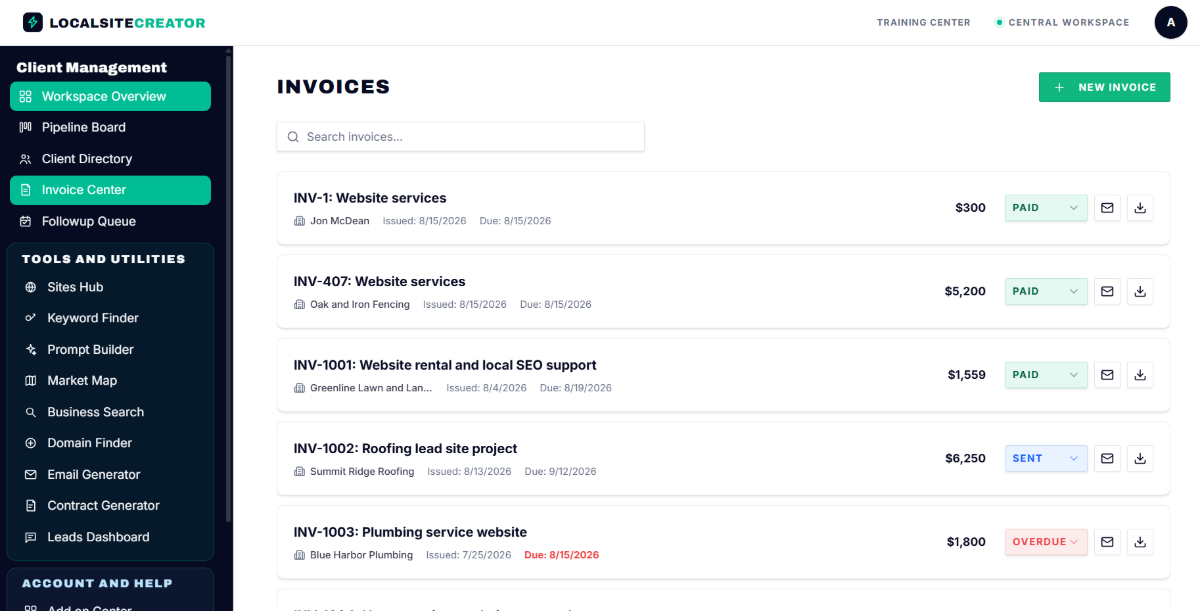
The core idea is simple. Instead of stitching together five or six different tools, you work inside one member dashboard. From there you can create sites, manage clients and, if you choose, unlock extra modules for prospecting, keyword research, domain hunting, outreach, contracts, lead handling and portfolio monitoring.
What stands out is that the platform does not stop at building a website. Many website builders hand you a page and wish you luck. Local Site Creator seems to be designed around the whole business cycle: find the market, build the asset, pitch the buyer, close the deal and manage what you own. That wider focus is the main reason it is worth a closer look.
Who Is Local Site Creator Actually For?
No tool fits everybody, so let me be clear about who will get the most from this one.
Beginners Who Want a Clear Path
If you are new to rank and rent, the biggest obstacle is usually not effort. It is confusion. You read ten blog posts, watch six videos and still do not know what to do on Monday morning. A platform that puts research, building and outreach under one roof gives you a visible path to follow, and that alone can save weeks of second-guessing.
Freelancers and Small Agencies
If you already build websites for local clients, you probably spend a lot of time on admin. Writing contracts, chasing signatures, copying leads out of emails and checking whether sites are online are all jobs that eat billable hours. Tools that automate those tasks can quietly add up to a real time saving every month.
Lead-Gen and Rank-and-Rent Operators
If your income depends on owning a portfolio of local sites, you need visibility. You want to know which sites are live, which are ranking, which are producing leads and which are rented. A central dashboard with uptime and ranking checks is exactly the kind of thing that matters once you own more than a handful of sites.
Who Should Probably Skip It
If you are looking for a magic button that makes money without effort, this is not it, and no honest tool is. Local lead generation still needs patience. Sites take time to rank, outreach takes time to land, and some niches are tougher than others. If you are not willing to put in consistent work for a few months, no software will rescue the plan.
==> Get The Full Local Site Creator Buying <==
How the Local Lead-Gen Model Works (A Quick Refresher)
Before judging any tool, it helps to understand the business it supports. Here is the model in plain language.
You choose a local service, such as emergency plumbing, junk removal or pressure washing. You pick a town where people search for that service. You build a simple website focused on that service and location, and you work to rank it in Google search results and, in many cases, on the map listings. Once the site starts to bring in calls and form submissions, you approach a local business and offer them those leads, usually for a monthly fee. Some operators prefer to sell the site outright for a one-time payment instead.
The beauty of this model is that the website is an asset you own. The challenge is that every step requires decisions, and a wrong decision early on, like choosing a crowded keyword or a weak market, can waste months. That is why research and outreach tools matter just as much as the site builder itself.
Key Features and Workflow Inside the Dashboard
Based on the platform's structure, the workflow is built around a member dashboard where you manage sites and clients and add specialist modules as needed. Let me describe how a typical session might look when you put the pieces together.
Step 1: Find the Opportunity
You start by identifying a niche and a city. This is where prospecting and keyword tools come in. You want a service people actively pay for, in a market where the competition is beatable. Rushing this step is the most common mistake beginners make, so having research tools inside the same system is a real advantage.
Step 2: Secure the Domain and Build the Site
Once the market looks promising, you choose a domain and build the site. A clean, fast, locally focused website with clear calls to action is usually enough to get started. The platform is designed to help you launch these sites without needing to code, which opens the door for non-technical users.
Step 3: Find and Pitch a Buyer
With a site ready, you look for local businesses that would benefit from it. Outreach is where many people stall, because writing cold emails from scratch is tiring and easy to put off. Ready-made, niche-specific sequences take away that blank-page problem.
Step 4: Close the Deal Properly
When a business says yes, you need a proper agreement. A signed contract protects both sides and makes the arrangement look professional. Handling that inside the same ecosystem keeps things tidy.
Step 5: Manage Leads and Monitor the Portfolio
After the deal, you track leads and watch your sites. If a form stops working or a site goes down, you want to know straight away, not three weeks later when the client complains.
That five-step loop is really what Local Site Creator is selling. The core platform handles the building and client side, and the add-ons plug into the other stages.
Local Site Creator Pricing & OTO / Add-On Breakdown
For buyers looking to customize their setup or unlock advanced automation capabilities, Local Site Creator offers a series of optional add-ons and upgrades available inside the member dashboard. Prices for the main platform can change from time to time, so always confirm the current front-end offer on the official sales page before you buy. What follows is the add-on and upgrade pricing.
Optional Add-Ons and Individual Upgrades
If you prefer to pick and choose specific tools tailored to your agency workflow, the following individual modules are available:
• GMB Miner: Collects visible Google Maps listings, organizes prospect research, filters opportunities, exports lists, and sends selected businesses to Client Management. (Original Price: $69 One-Time)
• Keyword Finder: Helps buyers find buyer-intent local service keywords and review competition before building a page. (Original Price: $29 One-Time)
• Market Map: Maps nearby cities with population and distance data so buyers can identify additional local markets. (Original Price: $79 One-Time)
• Domain Finder: Generates local service domain ideas and checks availability so buyers can choose a domain efficiently. (Original Price: $29 One-Time)
• Email Generator: Creates niche-specific outreach sequences for site rental, site sale, and audit campaigns. (Original Price: $39 One-Time)
• Contract Generator: Creates website rental or purchase agreements and sends them through an electronic signing workflow. (Original Price: $49 One-Time)
• Leads Manager: Collects contact form submissions from every site in one searchable inbox with notifications and CSV export. (Original Price: $79 One-Time)
• Sites Hub: Gives buyers one place to monitor uptime, review rankings, manage site status, and track portfolio details. (Original Price: $69 One-Time)
The Complete Add-On Bundle
If you want maximum utility without purchasing tools individually, you can opt for the Complete Add On Bundle. This package includes all eight optional add-ons in a single transaction.
• Bundle Price: $297 One-Time (Massive savings compared to purchasing each tool separately).
Doing the Math on the Bundle
Add up the eight individual prices and you get $442. The bundle costs $297, which means you keep roughly $145 in your pocket, a saving of about one third. If you know you will use most of the modules, the bundle is the more sensible purchase. If you only need two or three, buying them one by one will cost less overall.
A good rule of thumb: if the modules you want add up to more than about $297, take the bundle. For example, GMB Miner, Market Map, Leads Manager and Sites Hub alone come to $296, and at that point you are basically paying the same price for four tools or for all eight. Another thing worth noticing is that every item is a one-time payment. There is no monthly fee attached to these add-ons, which is a relief when your margins are still small.
==> Read The Truth Local Site Creator Today <==
A Closer Look at Each Add-On
A price list only tells half the story. Let me explain what each module does in everyday terms and who is likely to benefit from it.
GMB Miner ($69)
This is the prospecting engine. It gathers visible Google Maps listings, helps you organize your research, filters opportunities, exports lists and sends chosen businesses straight into Client Management. Finding the right prospects is half the battle in rank and rent. A weak business listing with few reviews and no website is often a sign that the owner could use your help, and a tool that lets you spot these quickly is useful.
The main benefit is speed. Doing this by hand means scrolling through map results, copying names into a spreadsheet and guessing which ones are worth contacting. Having it in one organized flow reduces that grind. Remember, though, that a list is only as good as the follow-up you do with it.
Keyword Finder ($29)
Keyword research is where profitable sites begin. Keyword Finder focuses on buyer-intent local service keywords and lets you review the competition before you build a page. Buyer intent matters because someone searching for an emergency electrician is ready to call, while someone searching for wiring facts is just curious.
At $29, this is one of the cheapest modules, and it is arguably one of the most important. A single bad keyword choice can waste a whole month of effort, so a small spend here can protect a lot of time.
Market Map ($79)
Market Map shows nearby cities along with population and distance data. This helps you spot additional local markets around a place you already know. Once a niche works in one town, the natural next step is to repeat it in the surrounding towns.
This is the add-on for people who plan to scale. If you want one or two sites, you may never need it. If you want a portfolio of fifteen or twenty, mapping out neighboring markets becomes very handy.
Domain Finder ($29)
Naming a local site sounds trivial until you try it and discover that every sensible domain is taken. Domain Finder generates local service domain ideas and checks availability so you can pick one efficiently. It will not replace your own judgment, but it saves you from the cycle of typing ideas into a registrar one at a time.
Email Generator ($39)
This tool creates niche-specific outreach sequences for site rental, site sale and audit campaigns. Many people are good at building and ranking sites but freeze when it is time to write a pitch. Having ready-made sequences gives you a starting point that you can tweak into your own voice.
A small tip here: never send generated emails word for word. Add the owner's name, mention their town and reference something real about their business. Personal touches make the difference between being read and being deleted.
Contract Generator ($49)
Contract Generator creates website rental or purchase agreements and sends them through an electronic signing workflow. Handshake deals are risky. If a client stops paying or disputes what was agreed, a signed document protects you. Electronic signing also makes closing easier, because the client can sign from a phone in minutes.
One honest note: a generated contract is a template. If you are dealing with large sums or unusual terms, it is smart to have a local lawyer look over the wording once, then reuse it.
Leads Manager ($79)
Once you own several sites, contact form submissions end up scattered across many places. Leads Manager collects them all into one searchable inbox with notifications and CSV export. This matters more than it first appears. In a lead-gen business, leads are the product. Missing one is like a shop losing a sale.
The CSV export is useful for reporting. When you meet a client who rents a site, showing them a clear list of leads you delivered makes it much easier to justify your monthly fee.
Sites Hub ($69)
Sites Hub gives you one place to monitor uptime, review rankings, manage site status and track portfolio details. Think of it as the control room. When your portfolio grows, memory stops being a reliable system. You need a dashboard that tells you what is live, what is slipping and what is rented.
Real-World Example: How a Beginner Might Use These Tools
Let me paint a realistic picture. Imagine someone named Sara who wants to start in local lead generation. She decides on a service business, say garage door repair, in a mid-sized city.
She begins with Keyword Finder to see which phrases suggest buying intent and how crowded the results are. After picking a promising phrase, she uses Domain Finder to settle on a name. She builds the site inside the platform and waits for it to start getting traction.
While she waits, she uses GMB Miner to build a list of garage door companies in the area, filtering for those with weak online presence. She sends selected businesses to Client Management, then uses Email Generator to create an outreach sequence and tweaks it with her own voice.
When a company agrees to rent the site, she uses Contract Generator to send an agreement for e-signature. From then on, Leads Manager collects calls and form submissions, and Sites Hub keeps an eye on uptime and rankings. When the first site proves itself, she opens Market Map and finds three nearby towns to repeat the process.
Notice what happened. Sara never had to leave the ecosystem, and she was never left wondering what to do next. That clarity is the real value this kind of platform tries to offer. It will not guarantee results, but it does remove a lot of friction.
==> See My 30-Day Local Site Creator Here <==
Pros of Local Site Creator
• All-in-one approach: Research, building, outreach, contracts, leads and monitoring sit in one place instead of across many subscriptions.
• One-time pricing on add-ons: There are no recurring fees listed for the optional modules, which helps with cash flow.
• Modular buying: You can start small and add tools as your business grows.
• Beginner-friendly workflow: The structure follows the natural order of a rank-and-rent business.
• Good bundle value: The complete bundle saves roughly $145 over buying everything separately.
• Built for scale: Market Map, Leads Manager and Sites Hub make more sense as a portfolio grows.
Cons and Things to Watch
• Results depend on effort: Software speeds up the work, but ranking and closing deals still take time and persistence.
• Add-on costs can stack up: Individual purchases add up to $442, so decide carefully what you need.
• Data tools need responsible use: Prospecting tools only collect visible information, and you should always follow local laws and email regulations when doing outreach.
• Generated documents are templates: Contracts and emails should be reviewed and personalized, not sent blindly.
• Learning curve: Even simple platforms take a few days to understand, especially if you are brand new to local SEO.
Which Add-Ons Should You Buy First?
If you are watching your budget, you do not have to buy everything on day one. Here is a sensible order based on how the business actually unfolds.
Start with Keyword Finder and Domain Finder. Together they cost $58 and cover the two choices that shape every site: what to target and what to call it. Next, add Email Generator and Contract Generator for $88 combined once you are ready to approach buyers and close deals. After that, bring in GMB Miner when you want to speed up prospecting. Finally, as the portfolio grows, add Leads Manager, Sites Hub and Market Map.
On the other hand, if you are already committed and know you will be building multiple sites, jumping straight to the bundle makes more sense. You will skip the stop-and-start of buying tools one at a time and you will lock in the lower price.
Tips for Getting Better Results
• Pick one niche and one city first. Learn the process on a small scale before multiplying it.
• Choose services with high job value, such as roofing, towing or water damage, because clients can afford to pay more for leads.
• Check the competition before you build, never after.
• Personalize every outreach email, even if it is only a line or two.
• Track your leads from day one so you can prove value to your clients.
• Review your portfolio weekly. Small problems like a broken form are easy to fix when caught early.
• Be patient. Local sites commonly need weeks or months before they show steady traction.
How Does It Compare to Doing Everything Manually?
You can absolutely run a rank-and-rent business with a spreadsheet, a few free tools and a lot of copy-and-paste. Many people did exactly that for years. The trade-off is time. Each manual task, such as exporting map listings, writing a pitch, drafting a contract or checking whether your sites are up, may only take twenty minutes. Yet repeated across many sites and clients, those minutes turn into entire days.
Paying for a platform is really paying to get those hours back. If your time is worth anything to you, even a modest saving per week can justify the cost fairly quickly. The question is not whether automation is helpful, but whether you will actually use the tools enough to benefit from them.
Common Mistakes to Avoid When Starting Out
Even with good tools, certain mistakes keep tripping people up. Knowing them in advance can save you money and frustration.
Building Before Researching
It is tempting to jump straight into building because it feels like progress. But a beautiful site aimed at a keyword nobody searches, or one dominated by giant directories, will not bring in a single call. Spend real time on research first, and let the numbers guide you rather than your gut feeling.
Ignoring the Business Side
A ranking site is only half of the equation. If you have no buyer, you have no income. Start thinking about who might rent the site while you are still building it. Build a simple list of local companies early, and you will be ready to pitch the moment the first leads arrive.
Skipping Contracts and Tracking
Many beginners rely on verbal agreements and loose notes. That works until the first disagreement. Written agreements and clear lead records protect your income and your reputation. They also make you look like a professional, which helps when you want long-term clients.
Buying Every Tool at Once Without a Plan
It is easy to get excited and buy everything on the same day. Unless you have a clear plan to use each tool within the first few weeks, the money may sit idle. This is why the bundle only makes sense if you are truly committed to the business model, and why a staged approach is smarter for cautious buyers.
Support, Learning Curve and Long-Term Value
Any new platform takes a bit of time to learn, and Local Site Creator is no exception. The good news is that the workflow follows a natural order, so you rarely have to wonder which tool comes next. Set aside a weekend to explore the dashboard, click through each module and run a small test project. By the end of it, you will have a much better feel for how the pieces fit together.
As for long-term value, the one-time pricing is the biggest plus. Software that charges every month can quietly drain a small business, especially when income is uneven. Paying once for tools you keep using means your costs stay predictable while your portfolio grows. Of course, always check what future updates and support are included, since policies can change.
Is Local Site Creator Worth It? My Verdict
After going through the structure, the add-ons and the pricing, my view is positive but measured. Local Site Creator makes the most sense for people who are serious about building local lead-generation as a business and who want fewer moving parts. The workflow is logical, the add-on lineup covers the stages that usually cause trouble, and the one-time pricing is friendly to small budgets.
The bundle at $297 is the strongest offer in the lineup. It gives you eight tools for about two-thirds of what they would cost separately, and for anyone planning to scale beyond a single site, that is a fair deal. If you are just testing the waters, begin with the core platform and one or two inexpensive add-ons like Keyword Finder and Domain Finder, then expand as you earn.
Of course, no tool replaces effort, judgment and a bit of patience. Treat Local Site Creator as a helper that removes friction, not a shortcut around the work. Used that way, it can be a practical addition to a local SEO toolkit. Before you buy, take a moment to read the official terms and refund policy, so you know exactly what you are getting.
Final Thoughts
Local lead generation remains one of the more approachable online business models because the demand is real. People will always need plumbers, roofers and locksmiths, and they will always search online when something goes wrong. Local Site Creator tries to make that opportunity easier to reach by bringing the scattered parts of the process into one organized place.
If you decide to try it, start with a clear plan, keep your first project small and treat every tool as a way to save time rather than a guarantee of income. Measure what works, fix what does not and scale slowly. That patient, steady approach is what separates people who build lasting portfolios from those who quit after the first month.
Frequently Asked Questions (FAQs)
What is Local Site Creator?
It is a platform for building local service websites and managing the business around them, including clients, outreach and optional add-on tools.
Are the add-ons one-time payments?
Yes. Every add-on listed, including the complete bundle, is priced as a one-time payment.
How much does the Complete Add-On Bundle cost?
The bundle costs $297 one-time and includes all eight add-ons, compared with $442 if bought separately.
Do I need technical skills to use it?
No coding is needed, though a basic understanding of local SEO helps you get better results.
Is it good for beginners?
Yes, its step-by-step workflow suits beginners, but results still depend on consistent effort and patience.