Local Event Fortune AI Review Is It Worth Your Money Before You Buy?
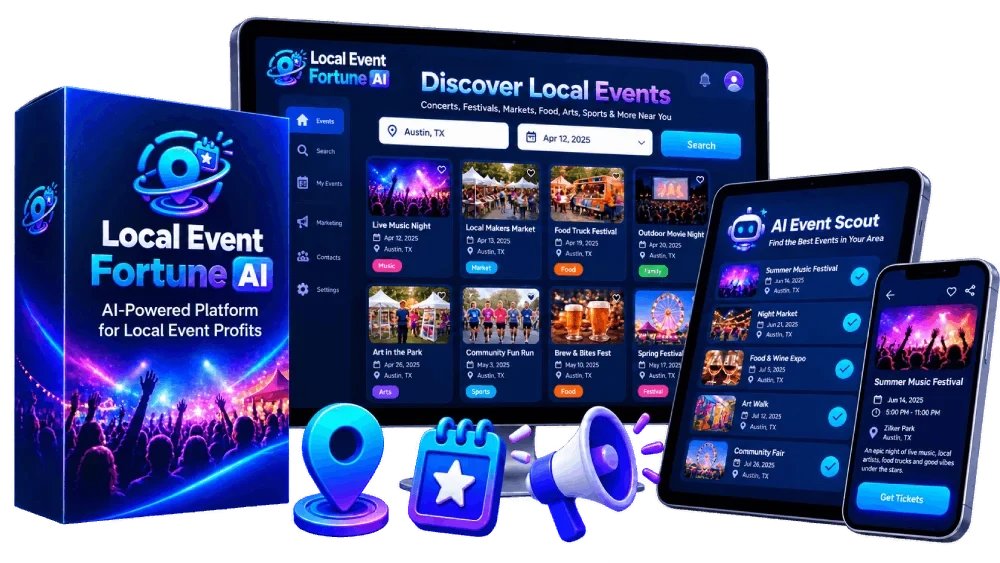
Let me guess how you got here. You saw a launch email or a banner somewhere, something about using AI to land local event clients, and you thought, "Okay, that sounds interesting, but what's the catch?"
Good instinct. Every launch has a catch, or at least a few things the sales page doesn't say out loud. So I went through the whole Local Event Fortune AI funnel, from the $27 front end to the $497 agency bundle, and put together this review the way I'd explain it to a friend who's about to spend money.
I'm not going to hype it and I'm not going to trash it. I'll tell you what each piece seems to be for, what it costs, who will get value from it, and who is better off keeping their wallet closed.
One quick note before we start: if you buy through links on this page, I may earn a commission at no extra cost to you. That's why I try to be extra honest here. If I oversell something and you feel burned, you won't read me again. Fair deal?
Let's get into it.
What Is Local Event Fortune AI?
Local Event Fortune AI is a software and training offer built around one idea: local events are a steady source of business, and AI can help you find, approach and serve the people who run them.
Think about everything that happens in a typical town. Weddings, charity dinners, school fundraisers, trade shows, community festivals, corporate mixers, birthday parties, product launches, church bazaars. Every one of those has an organizer, and every organizer needs vendors, promotion, signage, photography, catering, marketing help and a hundred other services.
That's the gap this product aims at. Instead of chasing generic "small business owners" with cold pitches nobody wants, you position yourself around event organizers who have real deadlines, real budgets and a real need for help.
From the product names in the funnel, you can see the pieces of that idea:
• An outreach builder aimed at event organizers
• A client documentation builder for handling events once you win them
• Agency sales materials for pitching and packaging services
• A service expansion roadmap for growing what you offer
• Two larger bundles that stack more tools together
So it's not just "an AI tool." It's trying to be a mini business system: find leads, pitch them, document the work, sell more services, and scale up.
Whether it pulls that off depends on how much of the work you're willing to do yourself, and I'll come back to that, because it matters more than any feature list.
Who Is It For?
Based on the way the funnel is structured, Local Event Fortune AI seems aimed at these people:
Beginners who want a niche. A lot of newcomers to online business fail because they pick nothing. "I'll help businesses with marketing" is vague and forgettable. "I help local event organizers get more attendees" is specific, and specific sells.
Freelancers and side-hustlers. If you already do design, social media, copywriting, video, SEO or virtual assistance, this gives you a target market and a way to approach them.
Small agency owners. The higher-tier offers, the Pro addon with a commercial license and the Agency Studio Bundle, point at people who want to serve clients and possibly resell or white-label.
Marketers who like AI tools. If you already use AI for content and outreach and like having templates and builders ready to go, you'll feel at home.
And who is it probably not for?
• Anyone hoping to press one button and watch money arrive
• People who hate talking to prospects, emailing, or following up
• Complete beginners who won't spend time learning the basics of selling a service
• Anyone who's already deep into a different niche and happy with it
That last point matters. A tool can't fix a lack of effort or a lack of interest. It can only shorten the road for somebody already willing to walk it.
==> Get The Full Local Event Fortune AI Buying <==
How Local Event Fortune AI Works
I want to be careful here, because I only want to describe what I can support. What I can say, from the structure of the offer, is that the system works in stages.
Stage 1: Get the core product. The front end is $27. This is the foundation, the main AI-driven toolset and training that introduces the local event approach.
Stage 2: Reach out to organizers. The first bump, the Event Organizer Outreach Builder, is about creating outreach messages for event organizers. Anyone who's done cold outreach knows the hardest part is writing something that doesn't sound like every other pitch in the inbox. A builder that produces tailored messages for a specific audience saves time.
Stage 3: Handle clients professionally. The Event Client Documentation Builder deals with the less glamorous side: proposals, agreements, checklists, briefs and the paperwork that makes you look like a real business instead of a hobbyist.
Stage 4: Sell it properly. The Agency Sales Materials bump covers things like pitch decks, one-sheets, service menus and sales scripts, the stuff you need once someone says, "Okay, tell me more."
Stage 5: Grow. The Service Expansion Roadmap is about what to offer next after your first few clients. Smart idea, since the real money in service businesses usually comes from repeat clients and add-on services, not one-off jobs.
Stage 6: Go big. The two bundles combine more tools and, presumably, more rights and resources for people who want to run this as an agency.
Notice the pattern: every step solves a problem that shows up right after the previous one. That's good funnel design. Whether it's good for you comes down to whether you actually need each step.
Local Event Fortune AI Pricing: The Full Breakdown
Here's what the funnel looks like, based on the pricing in the screenshot:
|
Product |
Price |
|
Local Event Fortune AI (Front End) |
$27.00 |
|
FE Bump: Event Organizer Outreach Builder |
$16.95 |
|
Bright Cloud Fortune Launch Special: Yearly Plan, 1 Site |
$297.00 |
|
Bright Cloud Fortune Launch Special: Yearly Plan, 2 Sites |
$497.00 |
|
OTO1: Premium Upgrade |
$47.00 |
|
OTO1 Bump: Event Client Documentation Builder |
$16.95 |
|
OTO2: Pro Addon + Commercial License |
$67.00 |
|
OTO2 Bump: Agency Sales Materials |
$16.95 |
|
OTO3: Service Expansion Roadmap |
$97.00 |
|
OTO5: Local Alchemist AI Bundle |
$247.00 |
|
OTO6: Agency Studio Bundle |
$497.00 |
Let me translate that, because funnel pricing can look more confusing than it is.
What you actually need to pay
Only $27 is required to get in. Everything else is optional. If you buy the front end and say "no thanks" to every upsell, you've spent $27 and that's it.
The cheap bumps
There are three bumps at $16.95 each: Outreach Builder, Client Documentation Builder and Agency Sales Materials. They're small impulse-sized add-ons. If you're serious about running this as a service, I'd say the Outreach Builder is the most useful for a beginner, since getting leads is the first problem you'll hit. The other two matter once you start winning work.
The mid-tier upgrades
OTO1 (Premium Upgrade, $47) and OTO2 (Pro Addon + Commercial License, $67) are the ones where you should pay attention to what you're getting. The commercial license is key if you plan to use the tools for paying clients. Without it, you may be limited to personal use, so read the license terms before relying on the basic version for client work.
OTO3 (Service Expansion Roadmap, $97) is a pure strategy and training product. It's valuable only if you actually reach the stage where you have clients and want to grow. If you're still at zero, skip it for now.
The big bundles
Local Alchemist AI Bundle ($247) and Agency Studio Bundle ($497) are the "everything" options. Bundles can be good value, but only when you'd have bought most of the pieces anyway. If you're fuzzy on what's inside, don't buy a bundle just because it looks like a discount.
A general principle I follow with every funnel like this: buy the cheapest entry, use it for a week or two, and upgrade only when you hit a real wall. Impulse purchases at the checkout page are how people end up with $500 of software they never open.
The Bright Cloud Fortune offer
You'll notice two entries called Bright Cloud Fortune Launch Special, a yearly plan for 1 site at $297 and for 2 sites at $497. The screenshot has info icons next to them, which usually means extra terms or recurring details. From the naming, this looks like a yearly subscription tied to sites, but I can't confirm exactly what it covers from the image alone.
So here's my advice: click that info icon and read exactly what's covered, whether it renews, and how much it renews for. A yearly plan priced like this should never be an "add to cart and forget" decision.
What if you bought everything?
Adding up every item in the list (leaving out Bright Cloud) comes to about $1,032.85. But the two bundles likely include some of the earlier pieces, so nobody should buy every single item. If a bundle covers what you want, buying the individual parts as well would be paying twice. Check the bundle contents first.
==> Read The Truth Local Event Fortune AI Today <==
The Upgrades, One by One
Front End: Local Event Fortune AI ($27)
This is the core, and for $27 it's an easy risk to take. At that price you're not betting your savings. You're paying about what a lunch costs to test a niche idea.
Who it's good for: anyone curious about the local event niche.
Verdict: Reasonable starting point. Buy this first, then decide on the rest.
Bump: Event Organizer Outreach Builder ($16.95)
Outreach is where most service businesses live or die. If you can write a good first message, you can get replies. If you can't, you stay stuck. A builder dedicated to event organizers means the messages can reference the real concerns organizers have: attendance, vendors, deadlines, budgets, sponsors and promotion.
Who it's good for: beginners who freeze when it's time to write a pitch.
Verdict: Worth considering at this price, especially if outreach is your weak spot. A caution, though: any AI-generated message should be edited so it sounds like you. If you copy and paste the same template to a hundred people, they'll notice.
OTO1: Premium Upgrade ($47)
The name is generic, and I don't want to invent features. A "premium upgrade" usually means more capacity, more templates, more features or advanced options compared to the basic version.
Who it's good for: people who've tried the front end and clearly want more.
Verdict: Don't buy on day one. Use the front end first. If you run into limits, you'll know exactly why you're upgrading.
OTO1 Bump: Event Client Documentation Builder ($16.95)
This is the "look professional" tool. Documentation might sound boring, but it protects you. Clear scopes of work, event briefs and checklists prevent the classic problem of a client assuming you'd do something that was never agreed.
Who it's good for: anyone about to take on a real paying client.
Verdict: Useful once you have clients. Before that, it's a "later" purchase.
OTO2: Pro Addon + Commercial License ($67)
This is the one I'd read most carefully. The commercial license is what typically lets you use the tool for client work and, in some cases, resell or offer services built with it.
Who it's good for: freelancers and agency owners using it with paying clients.
Verdict: If your plan is to serve clients, this is probably the most important upgrade in the funnel. If you only want to learn, skip it.
OTO2 Bump: Agency Sales Materials ($16.95)
Sales materials are the shortcut between "I can do this" and "here's what I charge." Pitch templates, service menus and proposal outlines make you look prepared.
Who it's good for: people building a service offer from scratch.
Verdict: Cheap and handy, but only if you'll customize it. Templates that look like everyone else's lose their power quickly.
OTO3: Service Expansion Roadmap ($97)
This one's about what comes after your first wins. Maybe photography leads to social media management, or event promotion leads to sponsorship outreach and email campaigns.
Who it's good for: people already earning from the niche.
Verdict: Decent idea, but $97 is steep for a roadmap if you're a beginner. Get your first clients before you plan how to grow.
OTO5: Local Alchemist AI Bundle ($247)
A mid-sized bundle. I'd treat it as a "maybe." The right question is: what's inside, and how much of it would you have bought separately anyway?
Verdict: Good only if the bundle contents match what you actually need. Compare it to the sum of individual items before deciding.
OTO6: Agency Studio Bundle ($497)
The top of the funnel and the most serious commitment. It's aimed at people who want to run an agency, serve multiple clients and use more advanced resources.
Verdict: Only for people with a real plan and some experience selling services. Beginners don't need this on day one. If you do get serious later, it may make sense.
What I Like
1. The niche is specific. "Local event organizers" is a clear audience. Specific audiences are easier to message, easier to rank for and easier to remember. That's a real strength.
2. The entry price is low. $27 is hard to complain about. If it doesn't suit you, the loss is small.
3. The funnel follows a logical journey. Outreach, then documentation, then sales, then expansion. It matches the order in which a service business grows.
4. It's built around a real need. People always run events, and organizers are usually busy and happy to outsource tasks. Demand isn't going away.
5. Local beats generic. Local clients are easier to meet, easier to trust and often easier to keep than strangers online. You can even walk into a venue or attend a networking mixer.
What I'm Not Crazy About
No review is honest without a downside section.
1. A lot of upsells. I count at least nine paid add-ons beyond the front end. That's normal for this type of launch, but it can feel like being asked "do you want fries with that?" over and over. Pace yourself and don't let the checkout flow rush you.
2. Tools don't replace effort. Outreach builders write messages, but you still have to send them, follow up and handle the replies. No software does the selling for you.
3. The yearly plan needs scrutiny. The Bright Cloud offer at $297 or $497 per year isn't small. Read every detail, including renewal pricing, before you say yes.
4. Results will vary a lot. Someone with sales experience and good people skills might do well. Someone who sends five messages and quits won't. Any claim of guaranteed income should make you suspicious.
5. The AI-generated look. If everyone uses the same templates, organizers will start seeing the same style from every freelancer. You have to add your own voice.
==> See My 30-Day Local Event Fortune AI Here <==
Is Local Event Fortune AI Legit?
Short answer: it appears to be a real product offering real tools, not an obvious scam. It's priced openly, the funnel is structured clearly and the purpose is understandable.
But "legit" and "right for you" are different questions. A legitimate product can still be a bad purchase if you don't need it, can't use it or expect more than it can deliver.
Here's how I'd check any launch like this before paying:
• Look for a refund policy and read it. Know how many days you have and what the conditions are.
• Check whether support is reachable.
• Look at real demos, not just testimonials.
• Understand what each upgrade includes before clicking yes.
• Never pay for something because a timer is counting down. Those timers are marketing, and you can usually sleep on the decision.
Can You Really Make Money With It?
Honestly? Possibly, but not automatically.
Here's a realistic path. Suppose you buy the front end and the outreach builder for around $44 total. You choose one service, say event promotion on social media. You build a short list of local organizers, send personalized messages for a couple of weeks, and follow up politely. Some will ignore you, some will say no, and a few might say, "Actually, we do need help with this." Land one client at a modest monthly retainer and the tool has paid for itself many times over.
That's plausible. But notice what did the work: choosing a service, building a list, sending messages, following up. The AI sped up pieces of it.
Now the unrealistic path: you buy everything, expect clients to appear, and wonder why nothing happens. That one doesn't work with any product on the market.
So the money isn't in the software. It's in the outreach, the service you deliver and the relationships you build. The software is an assistant.
Tips to Get the Most Out of It
Start small. Buy the front end, spend a week with it and see how it feels. Decide on upgrades afterward.
Pick one service. Don't try to offer everything. "I help local events sell more tickets through social media" beats "I do marketing."
Edit everything the AI writes. Add real details: the event name, something you noticed about their last event, a specific idea. Personalization is what gets replies.
Build a small list first. Twenty well-researched organizers are better than two hundred random emails.
Follow up. Most deals happen after the second or third message. People are busy, not uninterested.
Document your work. Even a simple proposal and checklist makes you look reliable and protects both sides.
Track your numbers. How many messages sent, how many replies, how many calls. If you don't measure it, you can't improve it.
Keep expectations realistic. A first client within a month would be a good result for a beginner. Plan for slower, and be pleasantly surprised if it's faster.
Who Should Buy Local Event Fortune AI?
• You want a clear niche and a ready-made starting framework
• You're okay with outreach and talking to people
• You want to build a service business with low startup costs
• You're willing to start with the $27 tier and upgrade only when needed
• You like having templates and tools to speed up your workflow
Who Should Skip It?
• You want passive income with no work
• You're uncomfortable contacting strangers
• You've already got a system for finding clients that works
• You're tempted to buy the $497 bundle without first trying the basics
• You're short on money and can't afford to risk even small amounts
Local Event Fortune AI Alternatives
You don't have to buy any product to get into local event services. Free and cheaper routes exist:
• Do it manually. Use a spreadsheet, a free AI assistant for drafting messages, and your own research on local events.
• Use general AI tools. Free or low-cost chatbots can write outreach messages if you give them good prompts.
• Join local groups. Business networking events, chambers of commerce and event planner communities are full of potential clients.
• Use free template libraries. Proposal and contract templates are available online at no cost.
What a paid product gives you is speed and structure. If you value your time and want everything in one place, that can be worth $27 or more. If you enjoy figuring things out, the manual route works too.
My Final Verdict
So, is Local Event Fortune AI worth it?
Here's my honest take. The front end at $27 is an easy, low-risk way to explore a focused niche, and the funnel is organized in a way that mirrors how a service business actually grows. The cheap bumps can be helpful if you'll use them. The pro license matters if you'll work with paying clients. The bigger bundles and the yearly plan are for people with a real plan, not curiosity.
My advice in one line: start with the $27 core, maybe add the outreach builder, and don't spend more until you've seen results or hit a real limit.
Don't let a countdown timer or a long upsell sequence push you into spending hundreds of dollars on day one. A tool is only valuable when you use it, and the best way to find out whether you will is to start small.
If the local event niche excites you and you're ready to put in consistent effort, this could be a useful shortcut. If you're hoping for magic, save your money.
Frequently Asked Questions (FAQs)
1. What is Local Event Fortune AI?
It's an AI-driven software and training offer designed to help you find and serve local event organizers. It includes tools for outreach, client documentation, sales materials and growth planning, spread across a front-end product and several upgrades.
2. How much does Local Event Fortune AI cost?
The front end costs $27. After that, optional upgrades range from $16.95 bumps to bigger offers like $47, $67, $97, $247 and $497, plus a yearly Bright Cloud Fortune plan at $297 for one site or $497 for two sites.
3. Do I need to buy the upgrades?
No. Only the $27 front end is needed to get started. The upgrades are optional, and many people will be fine starting with the basics and adding more later.
4. What does the Event Organizer Outreach Builder do?
It's an add-on priced at $16.95 that helps you create outreach messages aimed at event organizers, so you spend less time writing pitches from scratch.
5. Do I need the commercial license?
If you plan to use the tools for paying clients, the Pro Addon + Commercial License at $67 is likely the one to look at. If you're only learning or using it for yourself, you may not need it. Always read the license terms before you buy.
6. What is the Bright Cloud Fortune Launch Special?
It's a yearly plan offered at $297 for one site and $497 for two sites. Check the details behind the info icon, including what it covers and what the renewal price is, before purchasing.
7. Is Local Event Fortune AI suitable for beginners?
Yes, it's designed with beginners in mind, particularly those who want a defined niche. That said, you still need to be willing to do outreach and follow-up, since no tool does that for you.
8. Can I make money with Local Event Fortune AI?
It's possible, but results depend on your effort, your outreach quality and the service you offer. The software helps with speed and structure, but income isn't guaranteed.
9. Is there a refund policy?
Most digital products like this offer some kind of refund window, but terms vary. Check the sales page and checkout for the exact policy before you pay.
10. Should I buy the Agency Studio Bundle first?
I wouldn't. It's $497 and best suited to people who already have experience, clients or a clear agency plan. Start with the front end and upgrade only when you have a real reason to.
11. Is Local Event Fortune AI a scam?
Nothing in the funnel looks like an obvious scam. It's openly priced and clearly structured. Still, do your own checking on refund terms, support and what each upgrade includes before purchasing.
12. Are there free alternatives?
Yes. You can use free AI chatbots, free templates and local networking to find event clients. A paid product mainly saves time and gives you structure.