AI Drama Series Review Can $17 Really Turn Short AI Mini-Series Into a Content Business?
Introduction
Short-form drama is everywhere right now. Open any video app and you will see it within a minute: a tense argument, a secret revealed, a cliffhanger that makes you tap "next episode" before you have even decided to. People binge these tiny stories the way they once binged full TV seasons, and the creators behind them are picking up views, followers and, in some cases, real income.
The catch has always been production. Writing scripts, finding visuals, recording voices, editing, and publishing one episode after another takes a crew or a huge amount of personal time. That is exactly the gap tools like AI Drama Series are trying to fill, and it is why this product has been getting attention from marketers and beginners alike.
In this AI Drama Series review, I want to go through it the way I would explain it to a friend who asked whether it is worth buying. We will look at what the software is, how it is meant to work, who benefits most, where the weak spots are, and what the whole sales funnel costs once you add the upgrades. I will also share two coupon codes at the end so you do not pay more than you have to.
What Is AI Drama Series?
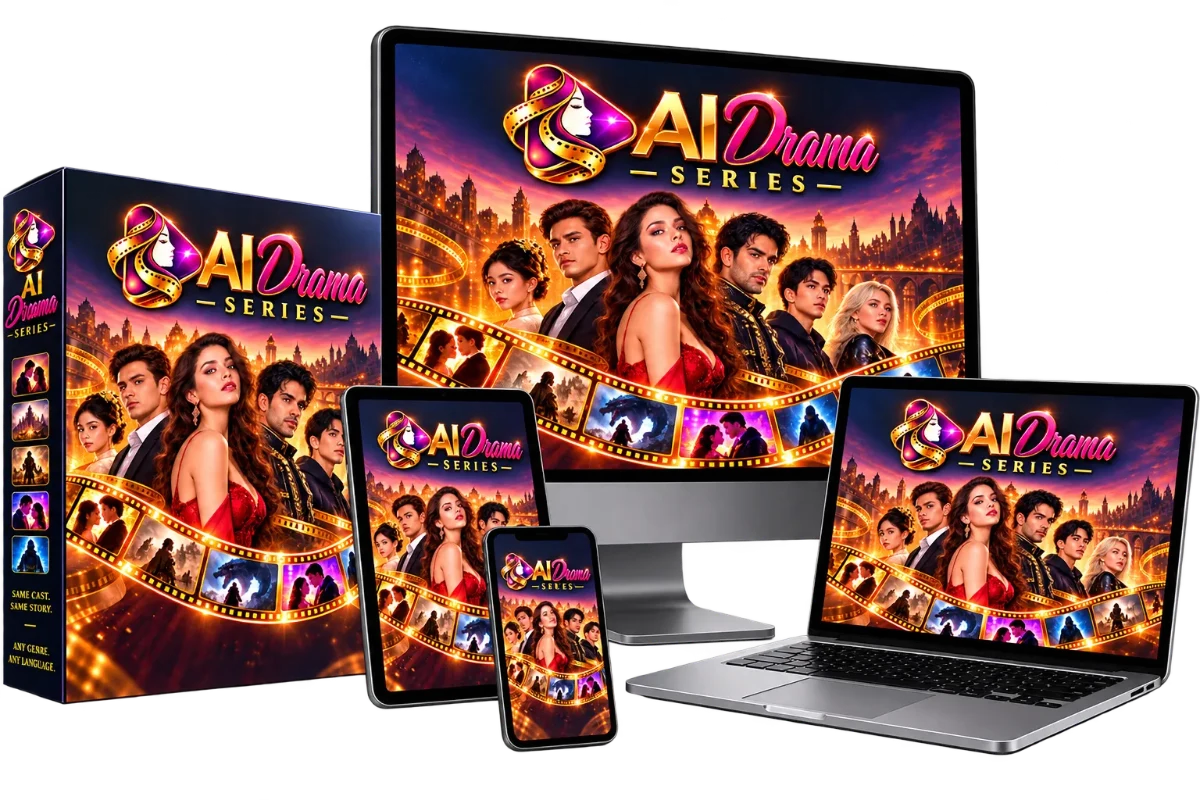
AI Drama Series is a software package built around one idea: you give it a story concept, and it helps you turn that concept into a finished, publish-ready mini-series made of short video episodes. The front-end version, priced at $17, is positioned as the foundation. It gives you the core tools to create and publish your first automated series without hiring actors, editors or voice artists.
Think of it as a small automated studio. Instead of juggling a script writer, a video editor, a voiceover tool and a scheduling app, the idea is that one dashboard handles the heavy lifting. You focus on picking a theme, such as romance, revenge, family secrets, workplace drama or thrillers, and the software helps produce the episodes around it.
It is important to be realistic here. No software can guarantee that a video will go viral or that a channel will make money. What a tool like this can do is remove the biggest barrier, which is the time and technical skill needed to produce consistent content. Whether that content succeeds still depends on your choices, your niche and how steadily you publish.
==> Get The Full AI Drama Series Buying <==
Why Short Drama Content Is Growing So Fast
To judge whether this product makes sense, it helps to understand the wave it is riding. Short dramas work because they match how people watch today. An episode takes about a minute, the story hooks you instantly, and every part ends on a moment that begs for the next one. There is no long setup and no commitment, so viewers keep going.
From a creator's point of view, there are a few more reasons the format is attractive:
• Repeat viewing. A good series pulls people back episode after episode, which helps watch time and follower growth.
• Easy to scale. Once you have a workflow, a new series is mostly a new story, not a new production setup.
• Faceless friendly. You do not need to appear on camera, which suits people who dislike being on video.
• Multiple platforms. The same vertical clips can usually be shared on several short-video platforms.
The problem is that most beginners quit before they see results because the work is heavy. Anything that cuts the workload gives a newcomer a better chance of staying consistent long enough to learn what works. That is the real pitch behind AI Drama Series.
How AI Drama Series Is Meant to Work
The process is designed to be simple enough for someone who has never edited a video. Based on how the product is presented, the flow looks like this.
First, you pick your story direction. That might be a genre, a character idea or a short premise. Second, the software builds out the series, handling the episode structure so each part carries the story forward. Third, visuals and voices are generated and combined into short episodes. Finally, you publish, either manually or, with certain upgrades, through automation.
What I like about this approach is that it keeps the creator in the director's chair. You are not asked to understand rendering settings or timelines. You are asked to make decisions about the story, which is the part that actually matters to an audience. If you have ever watched a dull video with polished visuals and a weak story, you already know why that is the right priority.
A small piece of advice from experience: do not treat the first output as final. Read the script, adjust the hook in the first few seconds, and make sure each episode ends with a reason to continue. The software can speed you up, but your editing instinct is what separates a forgettable series from one people follow.
Key Features Worth Knowing About
Rather than list every button, here are the capabilities that matter most when you are deciding whether to buy.
• Automated mini-series creation. The core promise. You start with an idea and get a structured series instead of a blank page.
• Short-form focus. The front-end is built around roughly 60-second clips, which fits the platforms where drama content performs best.
• Publishing support. You are not left with a folder of videos and no plan. The tools are meant to help you get episodes out consistently.
• Beginner-friendly workflow. No design or editing experience is required to get started, which lowers the barrier for first-time creators.
• Expandable through upgrades. Extra voices, languages, video engines and longer formats are available later if you outgrow the basics.
That last point deserves a note. The front-end is intentionally a starting point. Many of the more powerful options live in the upgrades, and I will break those down in a moment so you can decide what is truly necessary and what is optional.
Who Should Consider AI Drama Series?
Not every tool suits every person, so let me be direct about who gets the most out of this one.
• Complete beginners who want to try short-form storytelling without learning video editing.
• Faceless content creators who want to build channels without showing themselves on camera.
• Affiliate marketers and freelancers looking to offer video content or grow an audience for traffic.
• Busy side-hustlers who can spare a few hours a week but not a full production schedule.
On the other hand, if you are a professional filmmaker who needs total control over every frame, an automated tool will probably feel limiting. And if you expect to press one button and watch money arrive, you will be disappointed. This is a tool that saves effort, not one that replaces effort.
Pros and Cons
Every honest review should show both sides, so here is my balanced take.
What works well:
• The low entry price of $17 makes it easy to test the idea without a big commitment.
• It cuts a very time-consuming workflow down into something manageable.
• The faceless format removes a common psychological barrier for new creators.
• There is a clear path to grow, with upgrades for volume, languages, longer videos and done-for-you content.
• Commercial options exist for people who want to turn it into a service or resell it.
What to watch out for:
• Several of the most useful features, such as unlimited creation and extra engines, are in paid upgrades.
• Results depend heavily on the story quality, niche choice and consistency of posting.
• AI-generated content is becoming more common, so standing out requires creativity, not just volume.
• Platform rules about AI-made videos can change, so it is smart to stay updated on each platform's policies.
==> Read The Truth AI Drama Series Today <==
Inside the Funnel: Front-End, OTOs, and Pricing
If you are looking to pick up this software, it helps to know what options are available across the sales funnel. Below is the complete breakdown of the front-end offer and all the Optional Upgrades (OTOs) available during checkout.
• Front-End: AI Drama Series ($17) The core software package that gives you the foundational tools to start creating and publishing your first automated mini-series.
• OTO 1: Unlimited Edition ($67 / $97 - Downsell: $67) Removes limits on video creation, allowing you to scale your output and produce as many series and episodes as you want.
• OTO 2: Multi Video Engines ($67 / $97 - Downsell: $67) Unlocks advanced rendering engines to diversify your video styles and visual outputs.
• OTO 3: Multi Voice & Language Series ($47 / $67 - Downsell: $47) Expands your reach globally by adding multi-language support and a wider variety of emotional voice profiles.
• OTO 4: Long-Form Movie Edition ($67 / $97 - Downsell: $67) Enables you to transition from short 60-second clips into longer, cinematic movie-style productions.
• OTO 5: DFY Drama Series Pack ($127 / $197 - Downsell: $137) A "Done-For-You" package loaded with pre-made drama series campaigns so you can launch instantly without starting from scratch.
• OTO 6: Studio Autopilot Agents ($47 / $67 - Downsell: $47) Automates your publishing and workflow management using hands-free AI agents.
• OTO 7: Prime Series Machine ($97 / $147 - Downsell: $103) An advanced suite designed to maximize monetization and audience engagement loops.
• OTO 8: Franchise License ($97 - Downsell: $67) Gives you the rights to sell the product as your own and keep 100% of the profits across the funnel.
• OTO 9: Agency License ($147 - Downsell: $103) Allows you to set up accounts for clients and run an AI video creation agency.
• OTO 10: White Label License ($197 - Downsell: $137) Rebrand the software entirely with your own name, logo, and custom domain.
• OTO 11: AI Empire Bundle ($297 - Downsell: $207) The ultimate top-earner package that bundles multiple upgrades together at a heavily discounted rate.
Exclusive Coupon Codes to Save Money
Before you check out, make sure to apply these official discount codes to lower your total investment:
• AIDRAMAVIP: Take 30% OFF the full funnel.
• AIDRAMA3OFF: Take $3 OFF the full funnel.
Which Upgrades Do You Actually Need?
Seeing eleven upgrades can feel overwhelming, and I do not want anyone to spend money they do not need to. So let me sort them by how they fit different goals.
If you are just testing the waters, start with the $17 front-end alone. Make a few series, publish them, and see how the process feels. This costs very little and tells you whether you enjoy the work and whether the output matches your expectations.
If you find yourself hitting limits, the Unlimited Edition (OTO 1) is the logical first upgrade. Creating at volume is the main way to learn what your audience likes, and caps on creation slow that learning down. The Multi Video Engines (OTO 2) are more of a quality and variety choice, useful once you want your series to look different from everyone else's.
Multi Voice & Language Series (OTO 3) makes sense if you want to reach audiences beyond English. The same story in another language can open an entirely new viewer base, and voices with more emotion matter a lot in drama, where a flat line can ruin a scene. The Long-Form Movie Edition (OTO 4) is for creators who want to move beyond one-minute clips into something more cinematic.
The DFY Drama Series Pack (OTO 5) is attractive for people short on ideas or time, since pre-made campaigns let you launch immediately. Studio Autopilot Agents (OTO 6) and Prime Series Machine (OTO 7) are more about automation and monetization, and they are best added after you already have a working routine. Automating a process you have not yet figured out rarely helps.
Then come the business licenses. The Franchise License (OTO 8) lets you sell the product as your own, the Agency License (OTO 9) is meant for serving clients, and the White Label License (OTO 10) lets you rebrand everything under your own name and domain. These only make sense if you plan to build a business around the software. Casual users can skip all three without missing anything.
Finally, the AI Empire Bundle (OTO 11) combines multiple upgrades at a reduced total. If you already know you want most of the features, the bundle usually works out cheaper than buying each piece separately. If you are not sure, it is perfectly fine to wait. In many funnels, you can decide after trying the front-end.
==> Click Here to Get AI Drama Series + Bonus at a Discount Price <==
A Realistic Look at Results
Let me step away from features for a second and talk about expectations, because this is where most buyers get misled by hype.
Short-drama channels do not usually explode overnight. Most grow through repetition. You publish a series, check which episodes held attention, notice which hooks worked, and then improve the next one. The tool makes that loop faster because creation takes less time, which means you get more attempts in the same number of weeks.
A sensible plan for the first month looks something like this: choose one niche instead of five, publish consistently on one or two platforms, study your analytics weekly, and keep a note of which openings kept viewers watching. If you do that, the software becomes a real advantage. If you scatter your effort, even the best tool will not help much.
Monetization is another area to approach carefully. Income can come from platform rewards, affiliate links, driving traffic to your own offers, or selling video services to clients. Each route has its own rules and timeline, and none of them are instant. Treat any income promise, from this or any other product, with healthy skepticism.
Tips to Get the Most Out of It
• Start with a clear niche. Romance, revenge and mystery tend to hold attention well, but pick the genre you can keep producing.
• Write a strong first three seconds. Most viewers decide almost instantly whether to keep watching.
• End every episode on a cliffhanger. The goal is the next tap, not a neat conclusion.
• Stay consistent. Posting on a steady schedule beats posting a lot once and then disappearing.
• Check platform policies. Make sure you follow each platform's rules on AI-generated or synthetic media, including any disclosure requirements.
• Review before publishing. A quick read-through catches odd phrasing or awkward scenes the software may produce.
AI Drama Series vs. Doing Everything Manually
It helps to picture what the alternative looks like. To make one short drama series by hand, you would write the script, find or create visuals, record or buy voiceovers, edit everything together, add captions, export in the right format and then upload each episode. For a ten-episode series, that can easily swallow a full week of evenings.
With an automated tool, much of that is compressed. You still need good judgment, but you are no longer spending hours dragging clips around a timeline. The time you save can go into the things a tool cannot do for you, like studying what your viewers respond to and improving your hooks. That trade, less production time for more thinking time, is the strongest argument in favor of this kind of software.
Of course, manual production gives you total control and a unique look. If your goal is artistic expression, you may prefer that route. But if your goal is to publish regularly and test ideas quickly, automation is a much more practical fit.
Common Mistakes Buyers Should Avoid
• Buying every upgrade on day one. Start small, learn the tool, and expand only when you hit a real limit.
• Copying other creators exactly. Audiences notice repetitive stories. Add your own twist to the plot or characters.
• Ignoring analytics. Your numbers tell you which episodes worked. Check them weekly and adjust.
• Expecting instant income. Growth takes weeks or months of steady publishing, even with fast production.
• Skipping the story. Great visuals will not rescue a boring plot. Spend your energy on the idea and the hook.
Final Verdict
So, is AI Drama Series worth it? For $17, I think it is a reasonable low-risk way to explore short-form AI storytelling. It addresses the biggest obstacle for beginners, which is the sheer amount of work behind each episode, and it gives you a simple route from idea to published series.
The upgrades are optional, and I would encourage most people to hold off until they have proven to themselves that they will actually use the software. The business licenses in particular are meant for a specific type of buyer, not everyone. If you do decide to go deeper, use one of the coupon codes above, AIDRAMAVIP for 30% off or AIDRAMA3OFF for $3 off, so you are not paying full price.
As with any digital product, your results will come from your effort, your story ideas and your consistency, not from the software alone. Used that way, as a time-saving helper rather than a magic button, AI Drama Series can be a useful addition to a content creator's toolkit.
Frequently Asked Questions
1. What is AI Drama Series?
It is software that helps you create and publish automated mini-series made of short AI-generated video episodes.
2. How much does it cost?
The front-end costs $17. Optional upgrades range from $47 to $297, and coupons can reduce the total.
3. Do I need video editing skills?
No. It is designed for beginners, so you focus on the story while the software handles production.
4. Which coupon codes work?
Use AIDRAMAVIP for 30% off the full funnel or AIDRAMA3OFF for $3 off.
5. Do I need to buy all the upgrades?
No. The $17 front-end is enough to start, and you can add upgrades later if you need them.